

When the Mission Is Life-Changing, Technology Has to Keep Up
For more than 75 years, Hazelden Betty Ford Foundation has stood as one of the most trusted names in addiction treatment and mental health recovery in the United States. Serving patients across residential, virtual, and outpatient programs, the organization reaches tens of thousands of individuals and families each year, guided by a belief that recovery is possible for everyone, regardless of background or circumstance.
That reach is not accidental. It is the result of a deeply held institutional commitment: to remove every barrier standing between a person in need and the care that can change their life. At Hazelden Betty Ford, decisions are made with patients at the center, always.
As Brad Branham, Executive Director of Customer Engagement Technology, Hazelden Betty Ford, puts it, the foundation’s internal ethos is clear: “We focus on patients first, and our people are aligned on that.”
That alignment extends from the clinicians at the bedside to the technology team. For a long time, though, the technology itself was not keeping up. For many prospective patients and their families, the only way to reach Hazelden Betty Ford was a phone call. And that seemingly simple step carried enormous weight.
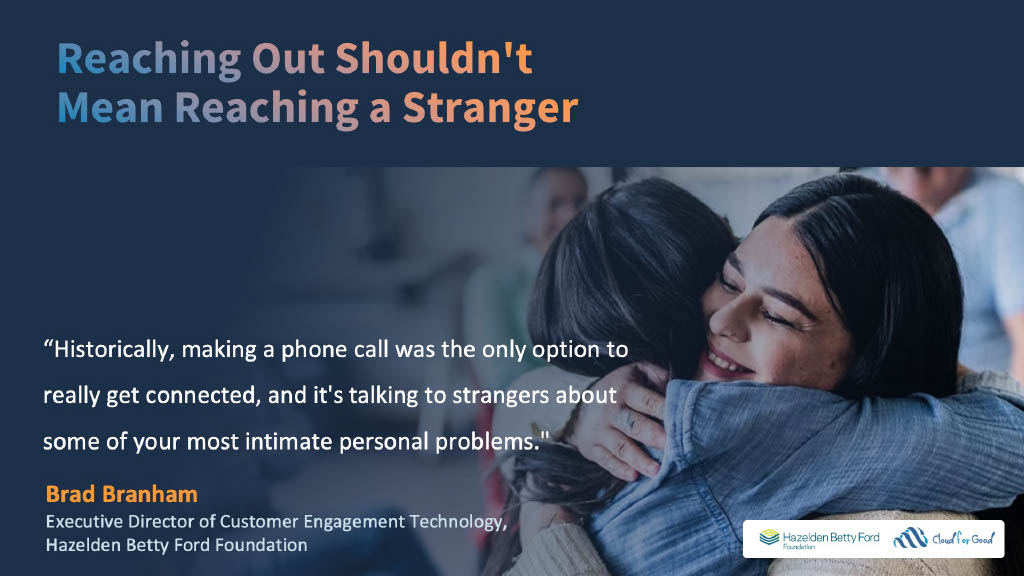
“Historically, making a phone call was the only option to really get connected,” Branham reflects, “and it’s talking to strangers about some of your most intimate personal problems.”
A Gap That Cost People More Than Time
Despite its long history and clinical credibility, Hazelden Betty Ford faced a challenge familiar to many mission-driven nonprofits: the tools available to connect with people in need had not kept pace with where people were actually looking for help.
For years, the primary pathway into care was a phone call. That single channel worked for some, but it created enormous friction for many others. Seeking help for addiction or mental health carries a stigma that still runs deep in most communities. Asking someone to call a stranger and discuss their most personal struggles, often during the most vulnerable moments of their lives, meant that a significant portion of people simply never made it through that door.
“Nobody really knows how to buy these types of services,” Branham explains. “Nobody knows what addiction typically really means until you’ve been through it, or what lifelong recovery steps you need to take, and what those options are to you.”
It is precisely that friction, compounded by stigma and limited digital access, that made transformation not just a technology project, but a mission-critical one. The foundation set its direction around a single organizing idea: “Amplifying human connection through intelligent digital pathways.” The next step was finding a partner who could build it.
The gap was not just emotional. It was also operational. When a prospective patient submitted insurance information, staff manually verified benefits, a process that regularly took 24 to 48 hours. For residential programs, that wait stretched up to a full week. In addiction care, where someone may be in a medically urgent situation, that kind of delay has real consequences. People lose momentum. They lose hope. Some lose their window entirely.
Hazelden Betty Ford knew they needed to move their digital front door much earlier in the patient journey, and they needed it to be available around the clock.
Choosing the Right Partner: Mission Before Methodology
When the foundation began evaluating implementation partners, the selection process was not driven by credentials alone. Branham and his team were looking for something less quantifiable but no less important: genuine alignment.
That search led them to Cloud for Good.
Over the course of two years and several smaller collaborative projects, the relationship between the two organizations deepened. What started as a professional evaluation became something more like a shared commitment.
Branham describes that evolution honestly: “It’s getting past the PowerPoints and all the great things that Cloud for Good does, but it’s hearing it in the reference calls, it’s seeing how you all execute, and you’re invested in what we’re doing.”
For an organization in the business of healing people, that investment matters. Cloud for Good’s name is not just branding. It reflects a team that works consistently with nonprofits and mission-driven organizations, bringing both technical depth and a genuine understanding of what is at stake when technology serves human outcomes.
What Cloud for Good Built: A Digital Front Door That Never Closes
The solution came in two interconnected parts, each targeting a different point of failure in the patient journey.
Salesforce Marketing Cloud Engagement: Reaching People Before They Ask
Before this implementation, Hazelden Betty Ford had limited ability to communicate proactively, at scale, across the channels their audiences actually used. Cloud for Good changed that by building a fully integrated marketing and communications platform on Salesforce Marketing Cloud Engagement.
The impact this created:
- Personalized, segmented outreach across email and SMS, so the right message reaches the right person at the right stage of their journey, whether they are still in the awareness phase or ready to commit to care.
- A connected data ecosystem that links marketing engagement back to the CRM, giving staff a real-time view of how prospective patients are interacting across every digital touchpoint.
- A patient-controlled subscription center that lets individuals choose how and when they hear from the foundation, building the kind of trust that a stigma-sensitive audience requires before taking the next step.
- Automated, insight-driven reporting so the team can see what is working, act on it quickly, and continuously improve how they engage people in need.
- SMS capabilities that made text-based outreach possible at scale, opening a channel that has proven particularly powerful for after-hours and weekend engagement.
Together, these capabilities moved Hazelden Betty Ford from a reactive communications model to a proactive one, meeting people much earlier in their journey.
Agentforce: From a Week-Long Wait to a 15-Minute Answer
The second piece addressed the most consequential friction point of all: insurance. Cloud for Good built an AI-powered eligibility agent, embedded directly on the Hazelden Betty Ford website, that guides prospective patients through the coverage question in real time.
Rather than facing a 24 to 48-hour wait, or up to a week for more intensive programs, a person can now:
- Receive a clear eligibility and cost estimate within minutes, at any hour of the day.
- Get directed toward alternative pathways, including financial aid options, when full coverage is not available.
- Choose to connect directly with a human specialist who picks up the conversation with full context already in hand.
The result is a patient experience that no longer asks someone in crisis to wait. It meets them where they are, with clarity and compassion, and keeps the door open even when the answer is complicated.
Results That Reflect the Mission
The data tells a compelling story. Since activating digital channels through the Salesforce platform, Hazelden Betty Ford has seen month-over-month growth in both digital engagement and admissions conversions. More people are reaching the foundation through digital pathways. More of them are completing the journey to care.
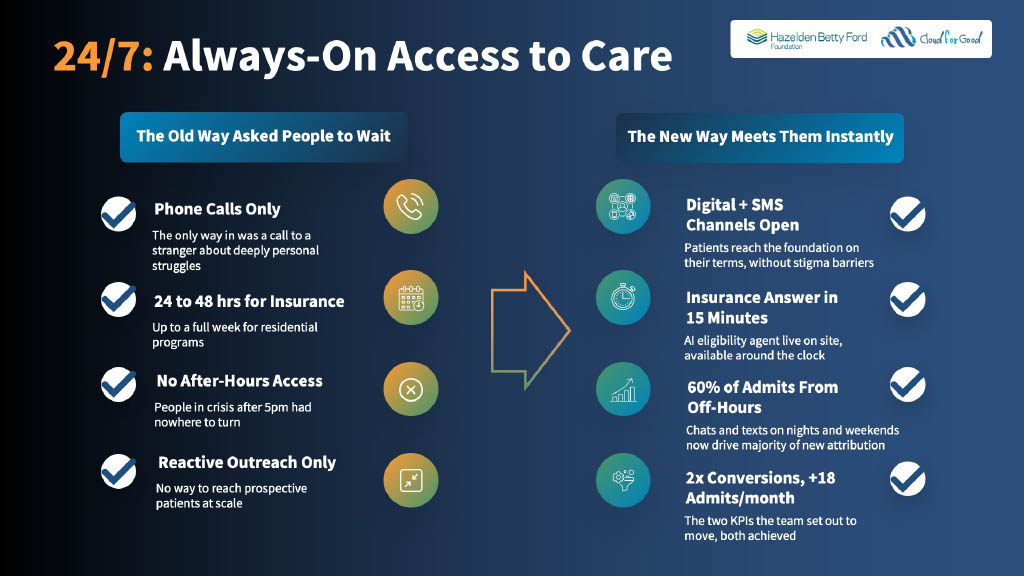
The foundation reported a twofold increase in conversion rates following the addition of digital channels, along with approximately 18 more patients admitted per month, directly attributed to those same channels. As Brad Branham notes, these were the two KPIs the team set out to move from the start.
The finding that stands out most, however, is one that reframes how the organization thinks about access entirely.
As Branham shares: “60% of that new attribution to admits was directly correlated to chats and texts being initiated off business hours and on the weekends.”
That number reveals something profound. The people who needed help most urgently, the ones reaching out at 4 a.m. on a Saturday, the ones who could not wait for Monday morning, were the very people the old system had been failing. Digital channels, available around the clock and powered by Salesforce, are now catching them.
Beyond patient impact, the workforce has also shifted. Staff can identify higher-qualified leads more quickly through digital signals, allowing them to redirect human attention where it matters most. The phone channel has not been replaced. It has become more valuable, because the people who reach it are further along in their commitment.
A Partnership Built on More Than a Statement of Work
Cloud for Good’s involvement with Hazelden Betty Ford continues to grow. And the strength of that relationship, according to Branham, comes down to something that cannot be written into a contract.
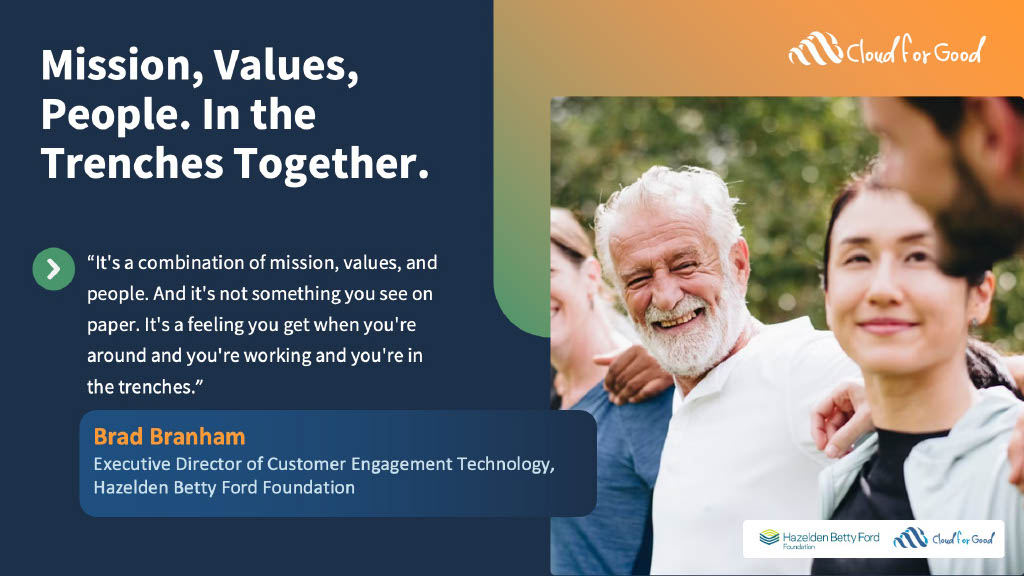
“It’s a combination of mission, values, and people,” he says. “And it’s not something you see on paper. It’s a feeling you get when you’re around and you’re working and you’re in the trenches.”
That feeling is what Cloud for Good works to bring to every engagement. For nonprofits operating with lean teams and limited capital, every technology investment has to count. Cloud for Good’s team brings not just Salesforce implementation expertise, but the strategic perspective to help organizations like Hazelden Betty Ford make those investments wisely and build foundations that scale. Technology, at its best, does not replace the human element in care. It clears the path to it. And that is exactly what this partnership set out to build.
Is Your Nonprofit Ready to Close the Gap Between Mission and Digital Reach?
Cloud for Good has helped hundreds of nonprofits and social impact organizations harness the power of Salesforce to serve more people, more effectively. Whether you are exploring Salesforce Marketing Cloud, Agentforce, or a broader digital transformation, our team brings the expertise and the mission alignment to make it count.
Talk to a Cloud for Good consultant today, and find out how we can help your organization amplify its impact.