

A two-way road.
Claude brings the intelligence. Salesforce holds the foundation, the data, and the rules that govern who can touch what. The security comes from how the two are built to work together.
In August 2026, that collaboration got a name: Claudeforce. The first product ships with 37 skills: meeting prep, daily briefings, call notes, pipeline review, relationship planning. The vocabulary is sales. The capability is universal.
Let us explore the dynamic, starting with the latest: Salesforce in Claude.
Salesforce in Claude: The New Direction
High-stakes conversations require context, and assembling that context is still largely a manual job. Before a major donor meeting, a gift officer pulls notes from three sources, checks giving history, and tries to hold it all together while preparing what they want to say. The work before the work is eating the time meant for the work itself.
Salesforce in Claude closes that gap. It is a plugin that connects your live Salesforce records to Claude, with Salesforce governing each step. It carries 37 pre-built skills. The open beta launched September 15, 2026, and is now available on all paid Claude plans. Read the official announcement here.
AIforce: Salesforce’s evolved architecture that makes the full platform, including data, workflows, business logic, and permissions, callable by AI over a standard MCP (Model Context Protocol) connection. An admin authorizes the connection once, and the whole team has it.

Governance: What Your Compliance Team Will Ask First
Your Salesforce permissions carry over untouched. Claude sees what each user is authorized to see and does only what they are authorized to do. There is nothing new to stand up or re-audit. An admin connects it once, and the whole team has it from day one.
You set how much Claude does on its own. It can pause for approval before sending anything to an external recipient, or proceed once your team is comfortable letting it. Record updates stay scoped to the specific field Claude names in advance. Salesforce sums up the division of labor this way: “Humans direct. Agents execute. Salesforce governs.”
Enterprise Frontier Safeguards, rolling out in phases from fall 2026, add a further layer: zero data retention across Sonnet, Opus, and Haiku; activity data held in cloud infrastructure you control, under your own encryption keys and with audit logging; and monitoring alerts sent directly to your team.
What this changes and what it leaves alone: governed access removes the barrier that has kept AI off the table for many regulated institutions. Your existing approval processes, compliance reviews, and regulatory obligations remain exactly as they were. This opens the door to evaluation. Adoption still requires the work your teams already know how to do.
The 37 Skills: What Each One Does and Where It Lands
Salesforce publicly names 15 of the 37 skills. They are organized around sales workflows. For Cloud for Good’s verticals, the capability underneath each skill is the same. The data being reasoned over is different. Here is what each named skill does and where it applies.
GitLab, Siemens, and Legora are among the organizations already running Salesforce in Claude, with 7,000 Salesforce users using it in their daily work.
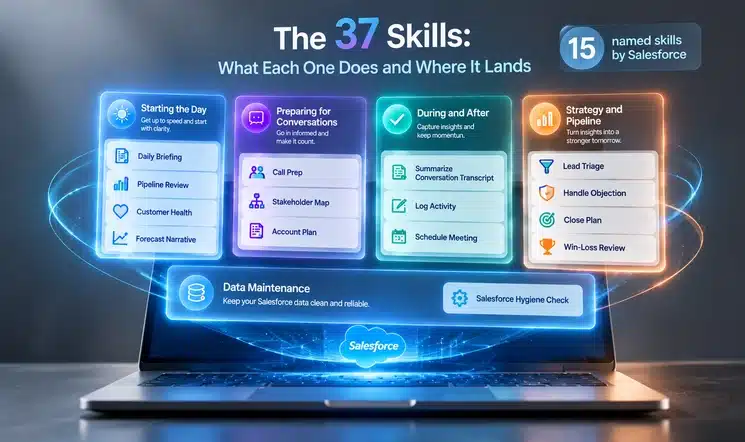
Starting the Day
Daily Briefing. Generates a morning summary of your most important activity, upcoming meetings, and priority records.
Nonprofit: A gift officer opens Claude to find a ranked summary of their top ten donor relationships, flagging who has gone quiet, whose pledge renewal is approaching, and who responded to last week’s outreach.
Pipeline Review. Surfaces the current state of your pipeline: where things stand, what has moved, and what is stalled.
Credit unions: A member services lead reviews which loan applications have stalled at which stage, which service requests have been open the longest, and which members have had multiple unresolved contacts.
Customer Health. Assesses the health of key relationships based on engagement signals, activity recency, and record completeness.
Higher education: A student success team uses health scores to identify which students have disengaged across multiple signals simultaneously, before any single signal would trigger an alert on its own.
Forecast Narrative. Produces a plain-language summary of where you stand against a goal and what is driving the gap.
State and local government: A program director reviews service-delivery progress against quarterly targets, with Claude explaining which programs are on track and which are falling behind.
Preparing for Conversations
Call Prep. Builds a pre-conversation brief from the full record history, including last touchpoint, open items, and relevant context.
Nonprofit: A major gifts officer prepares for a donor call with a one-page brief covering the full giving history, last conversation summary, open pledge status, and any program news relevant to their interests.
Stakeholder Map. Identifies and visualizes the key relationships around an account or record.
State and local government: A caseworker preparing for a family intake maps who is involved in the case, what each stakeholder’s role is, and where previous contacts have been documented in the record.
Account Plan. Generates a structured plan for deepening a relationship over time, based on record history and stated goals.
Higher education: A major gifts officer working with a long-term alumni prospect builds a multi-year engagement plan, with Claude pulling the relationship history and surfacing the most relevant program connections.
During and After the Conversation
Summarize Conversation Transcript. Reads a call or meeting transcript and produces a structured summary with key points, commitments, and follow-up items.
Credit unions: After a member services call, Claude produces a summary of what was discussed, what the member asked for, and what was committed, ready to be logged without the representative retyping the conversation.
Log Activity. Records a completed activity against the right record in Salesforce.
State and local government: A caseworker dictates a brief note after a home visit, and Claude writes the formatted activity log into the case record, with date, contact type, and outcome fields populated.
Schedule Meeting. Identifies availability and schedules a meeting against the relevant Salesforce record.
Nonprofit: A stewardship coordinator schedules a site visit with a foundation contact through Claude, with the meeting logged against the funder record automatically.
Strategy and Pipeline Management
Lead Triage. Prioritizes a list of prospects or incoming contacts by fit, urgency, and engagement signals.
Nonprofit: A development team reviewing a prospect pool asks Claude to rank new contacts by giving capacity signals, program alignment, and existing relationship strength before assigning them to gift officers.
Handle Objection. Prepares responses to anticipated concerns based on record context and prior conversation history.
Credit unions: A relationship banker preparing for a difficult member conversation reviews Claude’s suggested responses, grounded in the member’s history and the reasons for the decision.
Close Plan. Builds a structured plan for moving a specific opportunity to completion.
Nonprofit: A gift officer working toward a major gift ask builds a step-by-step plan covering who needs to be involved, what materials are needed, and the logical sequence of next conversations.
Win Loss Review. Analyzes a completed cycle to surface what worked, what did not, and what to carry forward.
Nonprofit: After a grant cycle closes, a development team uses Claude to pull the full application and communication history and generate a structured review for the next submission.
Data Maintenance
Salesforce Hygiene Check. Reviews records for completeness, duplicates, and missing required fields, then surfaces what needs attention.
All verticals: Before any AI-assisted workflow produces reliable output, the underlying records need to be clean. This skill brings data quality into the weekly routine as an active practice.
Claude in Salesforce: The Road That Already Existed
The other direction has been carrying traffic for the past year. Through Amazon Bedrock, Claude is available within the Salesforce Trust Boundary for regulated industries including financial services, healthcare, cybersecurity, and life sciences. Anthropic is the first LLM provider fully integrated within the Salesforce Trust Boundary, with all traffic contained within the Salesforce virtual private cloud. Organizations like CrowdStrike and RBC Wealth Management are already running Claude in Agentforce today. Cloud for Good has been deploying Agentforce in mission-driven environments across that same period.
An Agentforce agent handles inbound interactions inside Salesforce. A credit union member asks about a loan application at eleven at night. The agent reads the record, responds, logs the interaction, and escalates anything that requires human judgment. The staff member picks that up inside Salesforce the next morning.
The Real Difference Between the Two Directions
Both directions can support human-in-the-loop work and agentic automation. The distinction comes down to the surface: where the human interacts with and oversees the agents.
With Salesforce in Claude, the human works from within Claude. They ask questions, review outputs, approve actions, and manage relationships from the Claude interface. Salesforce runs in the background, governed and updated, but the person never has to open it.
With Claude in Agentforce, the human works from within Salesforce. Agents run inside the platform, handling interactions, routing cases, and flagging decisions that need a person. That person picks up the escalation inside Salesforce Lightning or through Slack.
The choice comes down to where your people already work and where you want agents to be visible.
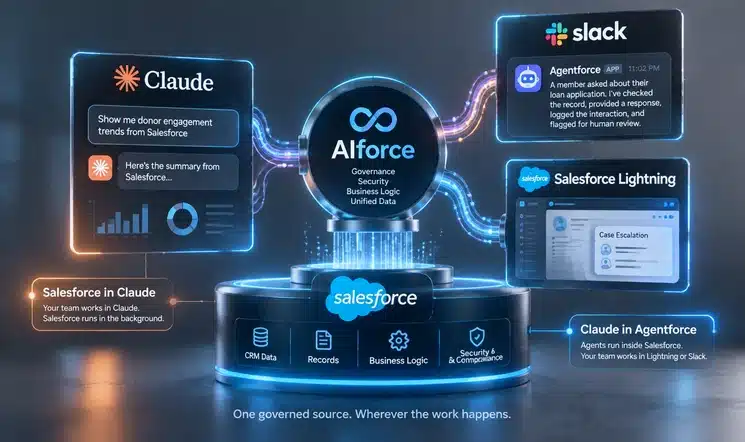
AIforce is the connective tissue for both directions. It exposes the same Salesforce data, business logic, and governance to any interface, whether your team works in Claude, in Slack, or inside Salesforce’s own Lightning interface. One governed source, wherever the work happens.

A full-stack morning, illustrative: A gift officer opens Claude and reviews a briefing on their top ten relationships. They flag one donor for outreach and ask Claude to draft a note, which they approve and send. Meanwhile, an Agentforce agent has already processed overnight gift activity, updated records, and flagged three lapsed donors. Slackbot surfaces those flags mid-morning. The officer picks them up. One platform, three interfaces, no manual assembly.
What Salesforce Has Said Is Coming
The initial 37 skills cover sales. Confirmed packages are in progress for Service, Marketing, Commerce, Revenue, Field Service, Tableau, MuleSoft, Informatica, Data 360, and AIforce.
The entry that matters most to mission-driven organizations is Industries: deploy industry-ready agents, automate specialized workflows, and act across every channel. Salesforce and Anthropic have already done this once, with Agentforce for financial services and healthcare. The Industries track is where that pattern extends to every vertical.
The Hard Part Nobody Puts in the Announcement
Salesforce describes the goal as grounding Claude in “the deterministic truth of your business.” The value of the whole architecture rests on your Salesforce records being accurate, complete, and current.
A donor record carrying three duplicate contacts produces a confident briefing built on a fractured history. A member file where transaction data never reaches Salesforce produces attrition signals that arrive after the member has already left. Salesforce included the hygiene check skill in the initial 37 for a reason.
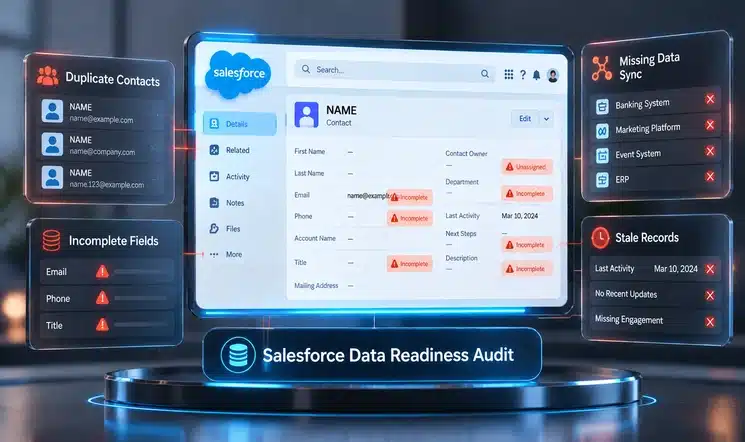
What we tell clients: before you evaluate either direction, audit the three or four objects that would power your first use case. Check for duplicates, check field completeness, and check whether the systems holding the relevant data actually write to Salesforce.
Where Cloud for Good Sits in This
Cloud for Good implements Agentforce for nonprofits, higher education institutions, financial services organizations, and government agencies. We know where the data readiness gaps sit in each vertical, and we know which use cases earn internal trust early and which ones require groundwork first.
The question we hear most often is where to start. Our answer: name the outcome you need, identify the data that supports it, audit that data honestly, and build the smallest version that proves the value.
Wondering whether your Salesforce data is ready for this? Talk to Cloud for Good.