

What Organizations Are Getting Wrong
The concerns are understandable. The answers are more reassuring than most organizations expect.
Every meaningful technology evolution brings questions with it. At Cloud for Good, we speak with IT leaders, program officers, executive directors, and digital strategy teams across nonprofits, higher education, public sector organizations, and financial services institutions about Salesforce Headless 360 every week. The same five questions come up repeatedly. This piece addresses each one directly.
If you are just getting started with Headless 360, we recommend reviewing our foundational piece, Salesforce Headless 360: Enhancing Your Salesforce Experience, before diving in. It covers what the architecture actually is and why it matters for mission-driven and customer-focused organizations alike. The myths below will make even more sense with that context.
MYTH 01 | Does going headless mean rebuilding everything from scratch?
“We have years of Salesforce investment we cannot afford to lose.“
This is the most common concern we hear, and it makes complete sense. Years of configuration, workflows, and data do not come cheap. The good news? Headless 360 does not touch any of it.
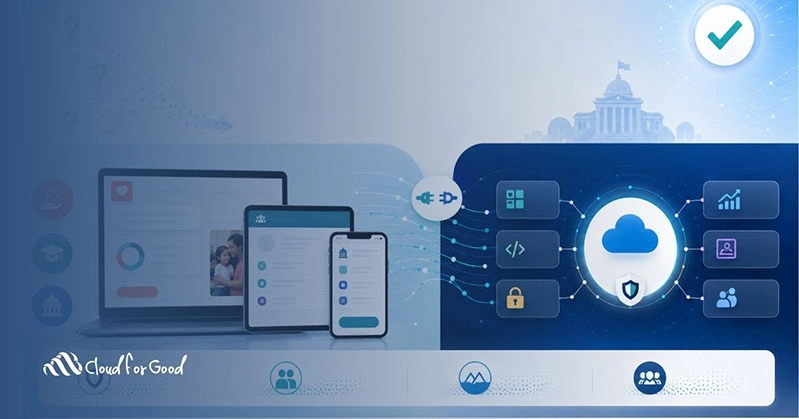
It is additive. Your existing Salesforce data model, automations, security rules, workflows, and integrations remain intact. The headless layer sits in front of your investment. It is a new delivery mechanism, not a replacement for the engine underneath.
At Cloud for Good, we always recommend starting small. Pick one well-defined use case: a donor portal, a student success hub, a program intake experience, or a customer onboarding journey in financial services. That first phase builds confidence and proves value without disrupting your existing Salesforce environment.
The Salesforce back end is extended, not rebuilt. Everything your team has built and configured stays intact.
MYTH 02 | Is this only realistic for large organizations with big internal development teams?
“We are lean.“
Headless architecture actually works in favor of smaller teams. The reason is simple: it separates technical responsibilities clearly.
- Salesforce admins continue managing data, configuration, and automation.
- Front-end developers, or your implementation partner, focus on the user experience layer.
Most of Cloud for Good’s clients, across nonprofits, higher education, public sector agencies, and financial institutions, do not have large internal tech teams. That has never been a barrier. The headless layer requires scoping, the right partner, and a phased approach that matches your organizational capacity.
Admins focus on Salesforce. Developers focus on experience. Each works in their lane, which is a feature, not a workaround.
MYTH 03 | Will we lose access to the Salesforce ecosystem?
“We rely on managed packages, AppExchange tools, and industry-specific Clouds.“
Headless does not remove or bypass the Salesforce ecosystem. Not even close.
- Managed packages, AppExchange apps, Nonprofit Cloud, Education Cloud, Financial Services Cloud, and Data Cloud all continue to operate exactly as before.
- Headless 360 adds a new delivery path, enabling more flexible, tailored front-end experiences while leveraging the same underlying data and workflows.
Many organizations use Salesforce’s native UI for internal workflows and a headless front end for constituent- or customer-facing experiences. It’s like adding a new front door: the building does not change; your users just get a better way in.
The Salesforce ecosystem stays intact. Headless simply adds a more flexible front door to the same trusted foundation.
MYTH 04 | Won’t decoupling the front end weaken our security posture or create compliance headaches?
“We can’t afford to introduce security or compliance risk.”
A thoughtfully designed headless architecture does not weaken security. In fact, it can strengthen it.
- Business rules, permissions, data access controls, and compliance logic are enforced at the API layer, before information reaches the front end.
- This creates a clear, auditable separation between what is displayed and what is stored.
For organizations operating under FERPA, HIPAA, GDPR, or state and federal grant requirements, that separation supports cleaner audit trails and more consistent enforcement across every channel.
Cloud for Good’s discovery and assessment phase ensures the architecture is designed right from the start, protecting security and compliance while enabling modern digital experiences.
MYTH 05 | How do we know this won’t become a costly, multi-year project that never delivers?
“We need to see value before committing to something bigger.”
Scope creep and delayed value are real concerns in any technology project. That is why Cloud for Good recommends a disciplined, phased approach.
- Start with one high-value use case.
- Demonstrate ROI quickly.
- Build a repeatable delivery pattern for future experiences.
Because the front-end layer operates independently, future improvements move faster. There are no full back-end development cycles standing in the way. Organizations that start focused and expand deliberately see strong, compounding returns.
Start focused. Prove value early. Then scale what works.
How Cloud for Good Approaches Headless 360
As a Salesforce Summit Partner serving nonprofits, higher education, public sector organizations, and financial services institutions, Cloud for Good brings mission- and outcome-driven thinking to every architectural decision. Our Headless 360 engagements follow a structured, four-phase approach designed to protect your investment, minimize risk, and deliver measurable value at each step.
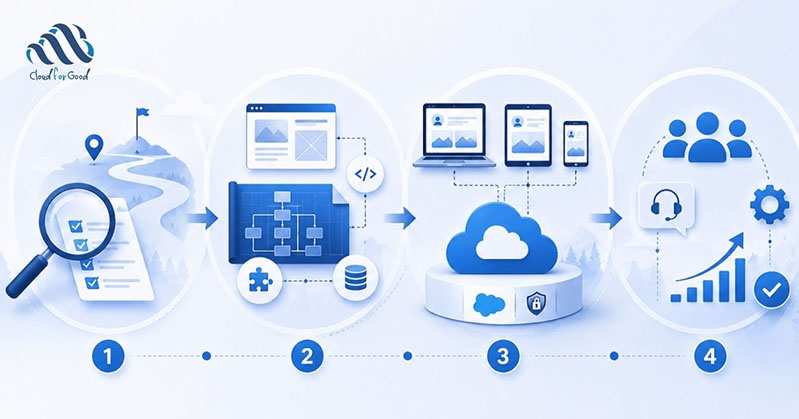
01 | Discovery and Readiness Assessment We assess your Salesforce environment, constituent or customer journeys, and organizational readiness to identify where headless capabilities deliver the fastest measurable outcomes.
02 | Architecture Design and Roadmap Our certified architects design a headless integration blueprint aligned to your budget, technical capacity, and strategic priorities, including API strategy, data model considerations, and long-term scalability.
03 | Phased Implementation We start with one clearly defined use case, whether a donor portal, student hub, customer portal, or program intake experience, build confidence, demonstrate ROI, and create a repeatable pattern for future experiences.
04 | Training, Adoption, and Ongoing Optimization We support both technical and non-technical teams through training, change management, and ongoing optimization so your headless capabilities continue to evolve alongside your mission or business goals.
“The right tools in the right hands can change the world. That has always been Cloud for Good’s belief. Salesforce Headless 360 is, for organizations ready to take that next step, one of those tools.” – Tal Frankfurt, Founder & CEO at Cloud for Good
Ready to Explore Headless 360 for Your Organization?
If any of the five questions above resonate, a conversation is worth having. Cloud for Good’s team of certified architects, developers, and sector specialists is ready to help you assess whether Headless 360 belongs in your roadmap and define a realistic, value-focused path forward.