

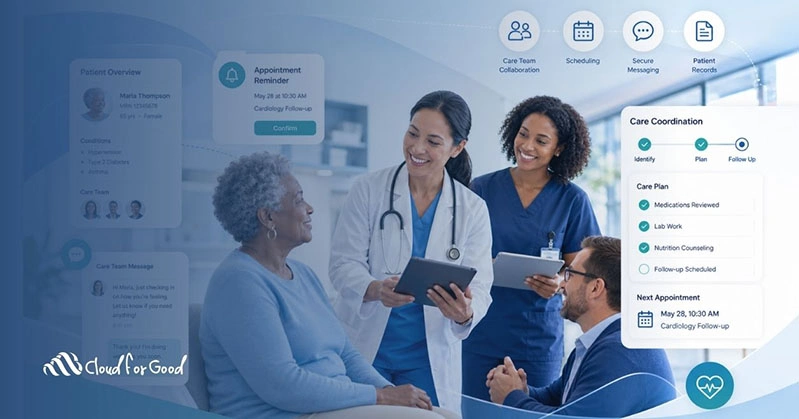
Healthcare Has Technology, But It Still Feels Disconnected
Healthcare organizations today operate in a highly digital environment. From electronic health records to scheduling systems and billing platforms, there is no shortage of technology supporting care delivery.
Yet, despite this investment, the experience often feels fragmented.
Patient data is spread across systems. Communication happens across disconnected channels. Care teams rely on manual coordination to fill the gaps. Each system works in isolation, but the patient experience spans across all of them.
This lack of connection is not just an inconvenience. It has a measurable impact on both cost and care quality.
According to McKinsey, administrative expenses account for nearly 25 percent of total healthcare spending, much of it driven by inefficient workflows and disconnected systems. At the same time, the Office of the National Coordinator for Health IT reports that one in five patients has identified errors in their medical records, often due to poor data coordination across platforms.
For patients, this means repeating the same information, experiencing delays, and navigating inconsistent interactions. For providers, it results in time spent on coordination instead of care, contributing to ongoing burnout across the industry.
At the same time, patient expectations are rising. Deloitte research shows that more than 70 percent of patients expect personalized and convenient healthcare experiences similar to those in other industries.
Healthcare organizations are beginning to recognize that the issue is not the absence of technology. It is the absence of connection between systems, data, and people.

Why Traditional Systems Alone Are Not Enough
Most healthcare platforms are designed as systems of record. They are essential for storing clinical information, but they are not built to manage engagement, workflows, or real-time care coordination.
This creates a gap between data and action.
Information exists, but it is not always accessible when it is needed most. Communication between teams often depends on manual processes. Tasks such as intake, referrals, and follow-ups require coordination across multiple systems, increasing complexity and slowing down care delivery.
As patient expectations continue to evolve, this gap becomes more difficult to ignore. Healthcare organizations need a way to connect their systems and turn data into meaningful, timely interactions.
How Salesforce Connects the Healthcare Experience
Salesforce addresses this challenge by acting as a system of engagement that works alongside existing clinical platforms.
Specifically, it creates a unified layer where patient data, communication, and workflows come together in one place.
- Patient interactions, appointments, and engagement history are connected into a single view
- Care teams no longer need to switch between systems to understand the full patient journey
- Providers can make decisions based on a complete, real-time picture rather than isolated data points
This connected view transforms how care is delivered.
As a result, communication becomes more consistent and proactive. Appointment reminders, follow-ups, and preventive outreach can be managed in a structured and scalable way. Instead of reacting to issues, organizations can engage patients at the right time with the right information.
These improvements go beyond efficiency. They directly impact outcomes. The Agency for Healthcare Research and Quality has found that effective patient engagement is associated with improved health outcomes, better care safety, and higher quality of care.
Reducing Administrative Burden and Improving Efficiency
One of the most persistent challenges in healthcare is administrative complexity.
The American Medical Association reports that physicians spend nearly twice as much time on administrative work as they do with patients. This imbalance affects productivity, increases costs, and contributes to burnout across the industry.
Salesforce helps address this directly by introducing automation across key workflows.
- Patient intake can move from manual forms to digital, automated processes
- Case routing and referrals can be managed through structured, trackable workflows
- Task management can be streamlined across care teams from a single interface
These changes reduce manual effort and improve consistency. Rather than relying on fragmented processes, organizations can build workflows that guide actions and ensure that nothing falls through the cracks.
Over time, this leads to more efficient operations and a better experience for both staff and patients.
Turning Data Into Actionable Insight
Healthcare organizations generate vast amounts of data, but much of it remains underutilized because it is spread across disconnected systems.
Salesforce brings this data together and makes it accessible in real time.
Because of that, leaders can monitor performance, identify trends, and respond to gaps as they emerge. This shift enables organizations to move from reactive decision-making to proactive planning.
Instead of relying on historical reports, teams can act on current insights to improve patient engagement, optimize workflows, and enhance care delivery across the organization.
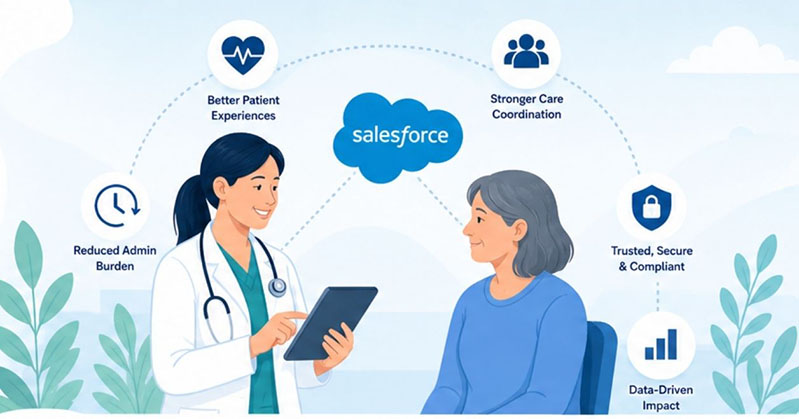
Protecting Patient Data: Privacy, Access, and HIPAA Compliance
As healthcare organizations share information more broadly across teams, systems, and locations, the stakes around data protection have never been higher.
According to IBM’s Cost of a Data Breach Report, healthcare has ranked as the most expensive industry for data breaches for 14 consecutive years. The average breach costs $9.77 million, which is more than double the cross-industry average. Furthermore, because healthcare breaches typically go undetected for 213 days, the damage is often significant before organizations even know an incident has occurred.
The scale of exposure is equally striking. The HHS Office for Civil Rights reports that more than 700 large healthcare data breaches are filed annually, and nearly one in three healthcare organizations has experienced an incident involving compromised user or administrative accounts.
The growing complexity of care coordination increases the risk of unauthorized access, data breaches, and HIPAA compliance gaps, making it harder to maintain patient trust and meet regulatory requirements. A fragmented technology environment only compounds this challenge, creating blind spots that put organizations at greater risk.
Salesforce addresses these challenges by providing a secure, centralized platform purpose-built for compliance. Key capabilities include:
- Role-based access controls that ensure patient data is only visible to the individuals who need it
- End-to-end encryption that protects data at rest and in transit
- Comprehensive audit capabilities that create a transparent record of all data access and changes
By combining strong security infrastructure with a unified data environment, Salesforce helps healthcare organizations reduce risk, maintain HIPAA compliance, and build the confidence needed to support more connected, patient-centered care. Rather than treating security as a separate concern, it becomes a foundational part of how the platform operates, enabling organizations to move faster without compromising on trust.
What This Looks Like in Practice
When systems are connected, the impact becomes visible across the entire patient journey.
- Patients can complete digital intake forms before appointments, reducing wait times and eliminating redundant data entry
- Care teams can access a shared view of the patient, improving coordination across departments and reducing delays
- Automated reminders and outreach campaigns help patients stay on track with appointments and treatment plans
- Communication becomes more consistent, improving engagement and the overall patient experience
For healthcare organizations with foundations, this connectivity extends even further.
- Patient and donor data can be aligned to create a more complete view of relationships
- Outreach can be personalized based on both care history and engagement history
- Fundraising efforts can be more closely tied to measurable patient impact
Together, these capabilities demonstrate how a connected healthcare CRM platform can improve both operational efficiency and long-term relationship management.
The Role of AI and Agentforce in Healthcare CRM
As healthcare organizations build more connected systems, the next step is scaling those capabilities with intelligence.
Salesforce Agentforce introduces AI-driven support that helps manage high-volume interactions and repetitive tasks across the care journey.
- Patients can receive instant responses to common questions at any time of day
- Scheduling and intake processes can be guided automatically, reducing friction for staff and patients alike
- Care teams can receive AI-powered recommendations for next steps, surfaced at the right moment in the workflow
This enhances the work of healthcare professionals by reducing repetitive tasks and allowing them to focus on more complex aspects of care. In a system already under significant pressure, that balance between automation and human interaction becomes critical.
Ready to Turn Connected Care Into Measurable Impact
Technology alone does not transform healthcare. Execution does.
Salesforce has the potential to unify patient data, streamline operations, and improve engagement across the care journey. However, real impact happens when that potential is translated into solutions that align with how healthcare organizations actually operate.
Cloud for Good partners with healthcare organizations to make that transition practical, scalable, and results-driven. From integrating Salesforce with existing systems to designing healthcare workflow automation that reflects real-world care delivery, the focus is always on outcomes that matter.
Whether you are exploring Salesforce for the first time or looking to optimize your current Salesforce Health Cloud investment, the next step is understanding what connected care can look like in your organization.
Connect with Cloud for Good to start building a healthcare experience that is more efficient, more coordinated, and designed for measurable ROI.