

For years, Blackbaud served as a reliable workhorse for nonprofit fundraising and higher education advancement. It tracked gifts, managed donor and alumni records, supported campaign activity, and generated year-end reports. For a simpler era of fundraising and advancement, it was enough.
That era is over.
Today’s mission-driven organizations, including nonprofits and higher education advancement teams, are navigating a more competitive and more digital landscape. Donors, alumni, parents, and members expect personalized outreach. Staff expect intuitive tools that eliminate busywork. Leaders expect real-time visibility into every metric that matters. And the rise of AI is creating a widening gap between organizations with connected data infrastructure and those still running on legacy systems.
If your team is spending hours on manual exports, struggling to connect donor data with marketing or programs, or losing sight of relationships across siloed platforms, the problem isn’t your people. It’s your platform.
Here is why now, specifically, is the right moment to make the move from Blackbaud to Salesforce, and how Cloud for Good helps mission-driven organizations implement Salesforce with a smarter, more connected foundation.
The Fundraising Landscape Has Shifted Dramatically
The data tells a clear story about where nonprofit fundraising stands today, and where the pressure points are building
1. Overall giving is growing, but donor counts are shrinking.
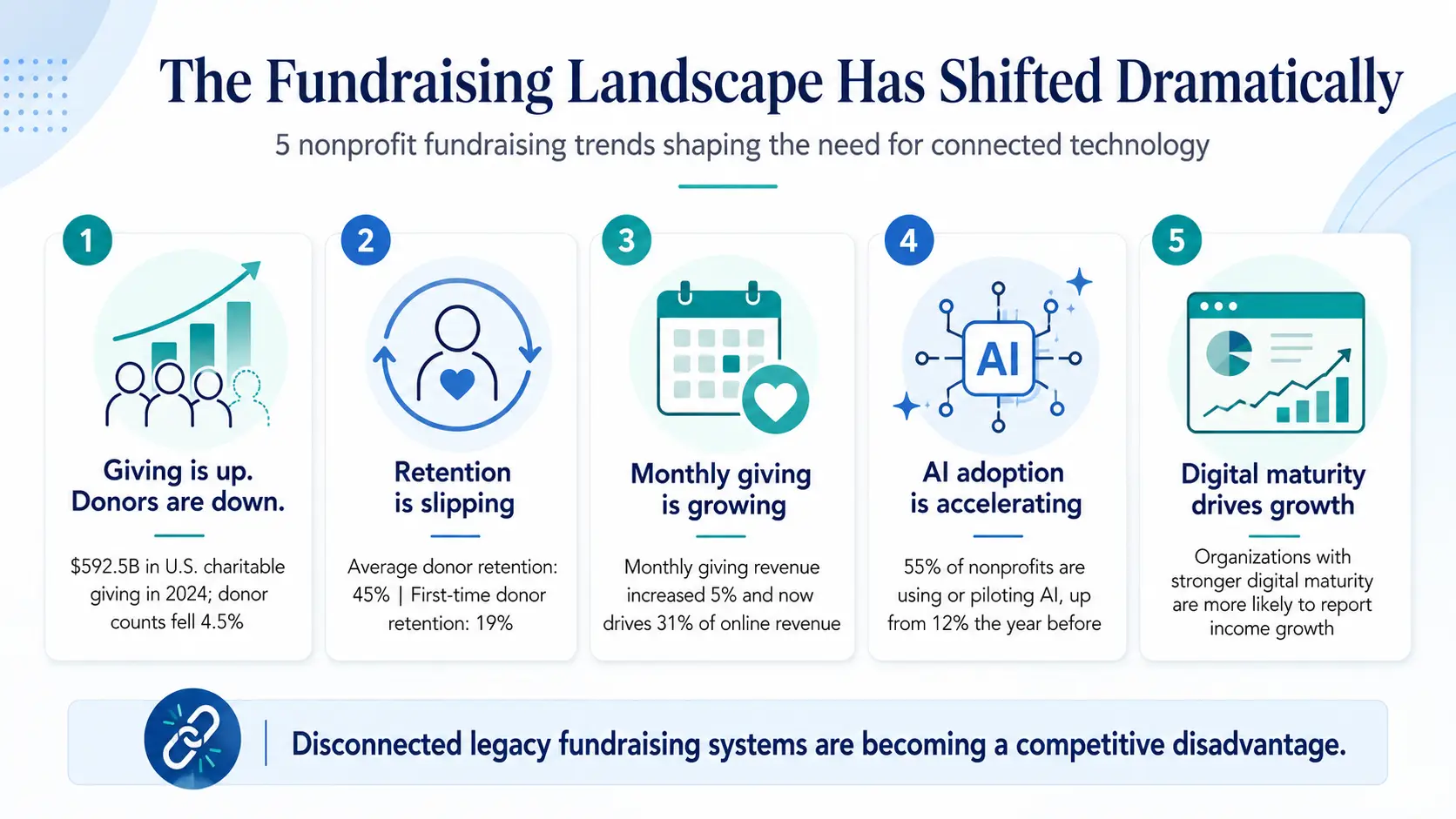
Total U.S. charitable giving reached an estimated $592.5 billion in 2024, according to Giving USA. Contributions grew 3.3% when adjusted for inflation. The opportunity is real. But underneath those headline numbers lies a structural problem: the Fundraising Effectiveness Project reported a 4.5% decline in total donor counts in 2024, the fourth consecutive year of decline. Fewer donors are generating more dollars, which makes retaining every existing relationship far more valuable than it used to be.
2. Donor retention is deteriorating at an alarming rate.
The average donor retention rate in 2024 was just 45%, down 2.6% from 2023, according to the Fundraising Effectiveness Project. First-time donor retention is even more striking; only 19% of first-time donors returned to give again in 2024. These numbers represent not just lost revenue, but lost relationships that legacy systems are structurally ill-equipped to rebuild. Retaining donors requires personalized, timely, behavior-driven engagement, something disconnected databases simply cannot deliver at scale.
3. Monthly giving is the fastest-growing revenue stream.
M+R Benchmarks 2025 found that monthly giving programs showed a 5% revenue increase in 2024, and monthly giving now accounts for 31% of all online revenue. Recurring giving is no longer a nice-to-have; it is a cornerstone of sustainable nonprofit finance. But managing recurring donor relationships well requires connected insight across payment data, communication history, campaign activity, and donor behavior. That kind of connection is difficult to achieve in siloed systems.
4. AI adoption in the nonprofit sector is accelerating.
Salesforce’s 2025 Nonprofit Trends Report found that 55% of nonprofits are actively using or piloting AI, a dramatic jump from just 12% the prior year. Organizations that harness AI for donor prospecting, content personalization, segmentation, and workflow automation are gaining measurable advantages. But there is a prerequisite: AI needs clean, connected, well-governed data to function. Organizations still managing fragmented records across legacy systems are not yet positioned to unlock what AI can offer.
5. Digital maturity drives revenue growth.
Research from the Blackbaud Institute’s Status of Fundraising 2025 report found that North American nonprofits with above-average digital maturity scores were significantly more likely to report income growth than their less digitally mature peers, specifically because they were using their donor management systems more efficiently. Technology investment is not just an operational decision. It is a revenue strategy.
Together, these five data points converge on the same conclusion: organizations that rely on disconnected, legacy fundraising technology are increasingly at a disadvantage.
Why Organizations Outgrow Blackbaud
Blackbaud’s core functionality, gift entry, campaign tracking, and basic reporting, was built for a more linear version of fundraising. But the reality of constituent relationships today is far more complex.
A single person in your database may be a donor, a volunteer, an event attendee, a board member, and a parent of a current student, all at once. If each of those interactions lives in a different system, your team can never see the full picture. A major gift officer might not know that a top prospect attended your annual gala last month. A marketing coordinator might not realize that a monthly donor also volunteers every weekend. A leadership team may have no visibility into how engagement activity correlates with giving over time.
Disconnected systems create disconnected relationships. And disconnected relationships create donor attrition.
For growing organizations, the limitations often show up as:
• Leadership reports that require manual data pulls and spreadsheet assembly.
• Siloed donor, marketing, program, and finance data with no unified view.
• Integrations that break down or require constant maintenance.
• Inconsistent reporting that erodes trust in data.
• Staff frustration that drives turnover and reduces efficiency.
These are not just operational inconveniences. They are signals that your technology is constraining your mission.
What Salesforce Makes Possible
Moving from Blackbaud to Salesforce is not simply a platform swap. It is an opportunity to redesign how your organization engages with donors, alumni, parents, members, and constituents, manages operations, and grows revenue, with a single, connected ecosystem at the center.
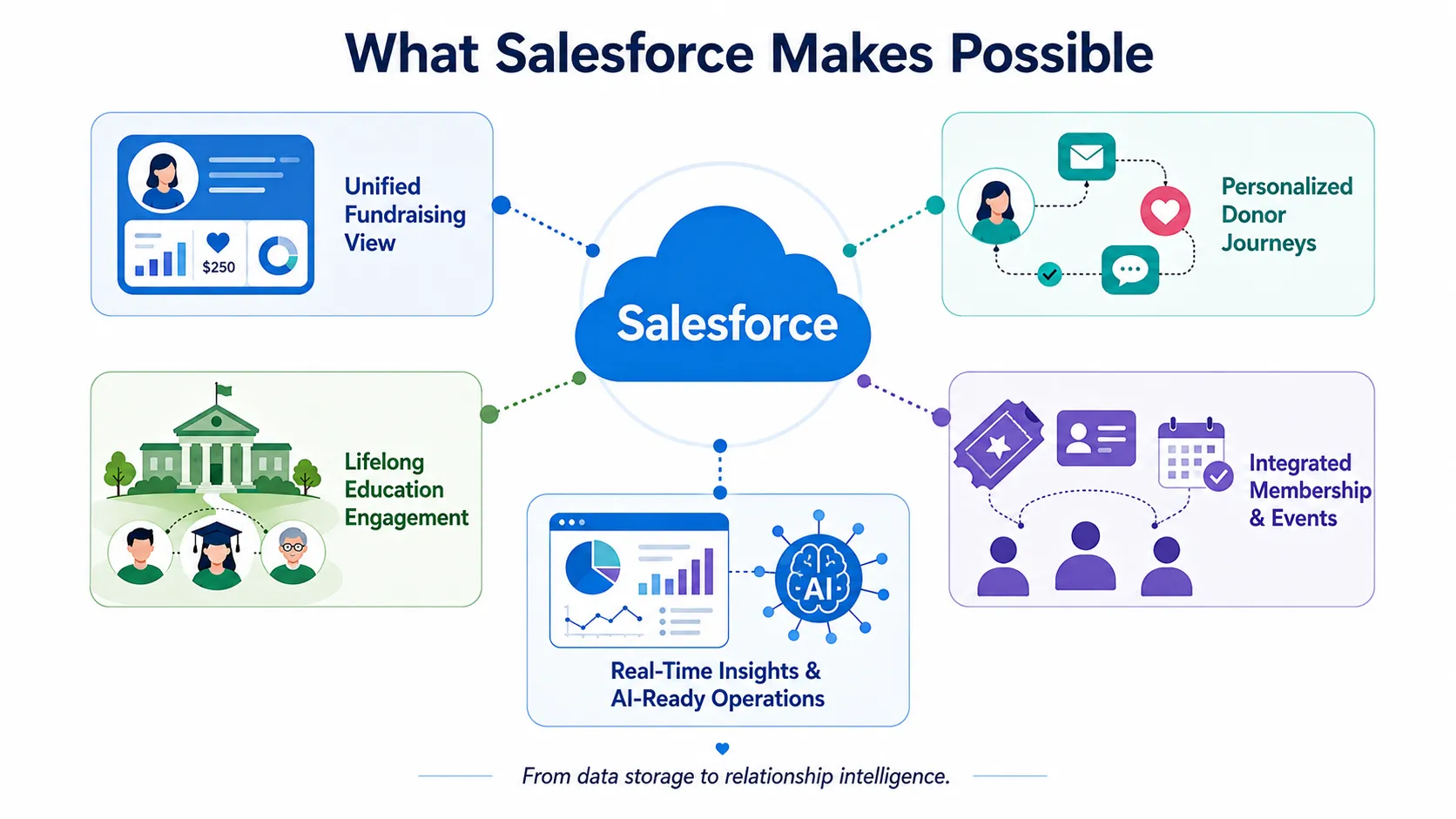
For development teams, Salesforce Nonprofit Cloud consolidates gift history, campaign involvement, relationship notes, pledge tracking, and next steps into one view. Major gift officers spend less time hunting for data and more time building relationships.
For donor retention, Salesforce enables automated, personalized stewardship journeys based on giving history, engagement behavior, and communication preferences. First-time donors, lapsed donors, and monthly donors can each receive tailored outreach without manual effort.
For advancement offices in higher education, Salesforce connects alumni, parent, student, and donor data to support lifelong engagement strategies. Advancement teams can align major gift pipelines with broader institutional relationship history.
For cultural institutions and membership organizations, Salesforce integrates ticketing, membership, events, and fundraising data. Organizations can finally understand the full arc of how a visitor becomes a member, and how a member becomes a long-term donor.
For leadership and strategy, Salesforce replaces static, retrospective reports with real-time dashboards. Campaign performance, recurring gift trends, donor retention metrics, and portfolio activity become visible the moment they change, not after a manual reporting cycle.
For AI-readiness, Salesforce provides the clean, connected data infrastructure that makes intelligent automation possible, from donor summaries and personalized outreach to next-best-action recommendations and predictive pipeline analysis.
All of these use cases represent the same fundamental shift: moving from data storage to relationship intelligence.
Why Waiting Makes the Problem Worse
Migration is not simple. Data cleanup, change management, staff training, and integration design are real challenges. It would be dishonest to suggest otherwise.
But the cost of delay is also real, and it compounds over time.
Every year spent on a disconnected system is another year of manual reporting overhead, missed donor signals, degraded data quality, and staff frustration. It is also another year of growing technical debt, as data becomes harder to clean, reconcile, and activate as complexity accumulates.
Why Cloud for Good
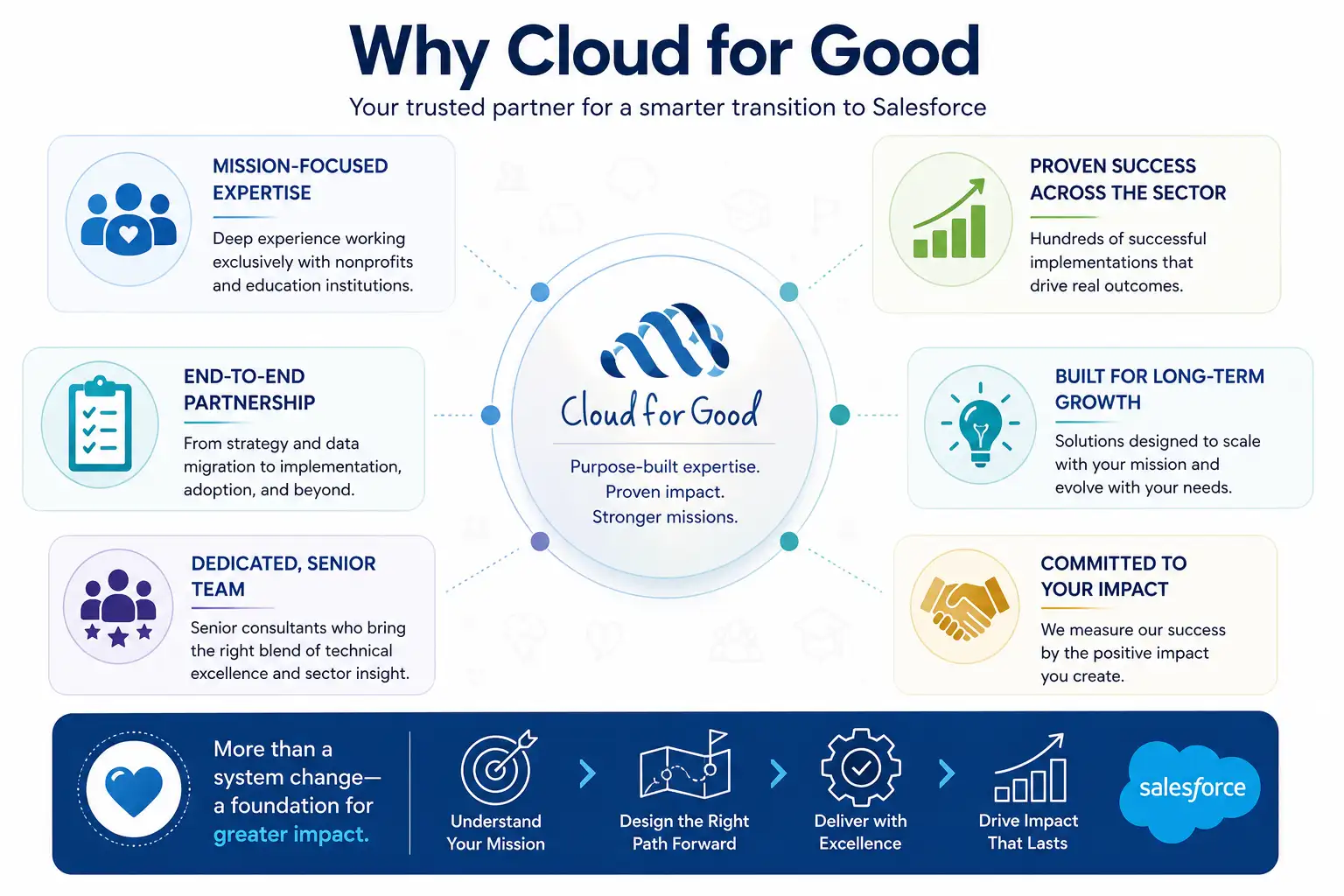
A successful migration from Blackbaud to Salesforce requires more than technical capability. It requires deep familiarity with nonprofit and education operations, strategic data migration planning, thoughtful change management, and a clear vision for how Salesforce will support long-term organizational growth.
Cloud for Good has spent over a decade helping mission-driven organizations make exactly this transition. Our implementation teams understand the complexity of fundraising, advancement, grants, memberships, programs, volunteers, households, events, and impact reporting because we have built these solutions across hundreds of nonprofit and education clients.
More importantly, we help organizations think beyond replacement. The goal is never to rebuild Blackbaud inside Salesforce. The goal is to design a better operating model, one that is purpose-built for the full constituent lifecycle.
That means helping your team answer the right questions before a single line of configuration is written. What data matters most and needs to come with you? Which manual processes should be automated from day one? How should your team segment and steward donors differently? What reports does leadership actually need? How should your Salesforce instance evolve as your mission scales?
With the right partner, migration becomes more than a system change. It becomes the foundation for a fundamentally stronger organization.
The Bottom Line
Blackbaud helped many organizations manage fundraising in a previous era of the sector. But the future belongs to organizations that are connected, personalized, data-driven, and AI-ready.
Salesforce gives organizations the platform to connect data, strengthen relationships, improve reporting, and scale with the mission. Cloud for Good gives them the partner to get there.
The time to leave Blackbaud is now. The path forward starts with a conversation.
Ready to explore what a move to Salesforce would look like for your organization? Contact Cloud for Good to speak with a nonprofit Salesforce implementation specialist.