


Joy Asakawa, Director of Sales, EDU
For years, higher education institutions have relied on integration platforms and middleware solutions
like Lingk to move critical data between their student information systems, learning management
systems, Salesforce, and the growing ecosystem of technologies that support the student journey.
But the technology landscape in higher education is changing. What was once primarily an integration
challenge, moving data reliably from one system to another, has evolved into a much broader
institutional imperative. Colleges and universities need a complete, connected view of their students,
data that can be turned into meaningful action, and a technology ecosystem that reduces complexity.
Increasingly, that same foundation must also prepare institutions for what comes next: trusted, scalable
AI that can put connected data to work across the student journey.
For institutions reconsidering their current integration strategy, this moment represents more than a
technology decision. It creates an opportunity to step back from years of point-to-point connections and evaluate whether the architecture supporting today’s institution is ready for a more connected, data-
driven future. For institutions evaluating alternatives to Lingk, Salesforce provides a path to build a more
connected institutional platform.
The Integration Challenge Has Changed
Historically, integration strategies were largely focused on moving data. An institution might need
student information from its SIS available in Salesforce. Engagement data might need to flow from the
LMS. Marketing systems, advising platforms, financial systems, event platforms, and dozens of other
applications each introduced another integration requirement.
Middleware helped solve an important problem by connecting those systems. Today, the challenge has
expanded. Institutions need to connect, harmonize, understand, govern, and activate information across
the entire learner lifecycle.
Salesforce’s education platform reflects that shift, supporting experiences across recruitment and
admissions, academic operations, student success, and advancement on a common platform. The
conversation has expanded. It is about building an institutional architecture that can support connected
experiences today and better outcomes over time.
Salesforce Offers More Than a Middleware Replacement
For institutions exploring alternatives to Lingk, replacing one standalone integration layer with another
may solve an immediate need, but it can also be a larger opportunity. Salesforce brings together
integration, data management, unified data, education-specific workflows, and AI capabilities as part of
a broader platform strategy.
MuleSoft: Connect the Systems That Power Your Institution
MuleSoft provides an enterprise integration layer for connecting your CRM with the systems higher
education institutions depend on. Salesforce supports SIS and LMS real-time integration through
MuleSoft, including connectors for platforms such as Canvas, Moodle, Blackboard, and D2L Brightspace.
Institutions can build reusable APIs and integration patterns that support a broader enterprise
architecture. As SIS, LMS, ERP, and other technologies evolve, this approach creates greater flexibility
without requiring the integration strategy to start over each time a system changes.
Informatica: Build Trust Into Your Data Foundation
Connecting institutional systems is only part of the challenge. As colleges and universities bring together
growing volumes of student, constituent, academic, financial, and engagement data, ensuring that data
is trusted, governed, and ready for use becomes just as important.
With Informatica, institutions can bring enterprise data management, data quality, governance,
metadata management, and integration capabilities into a broader data strategy. This helps address one of the biggest barriers to transformation: fragmented data that may be technically connected but
remains inconsistent, duplicated, or difficult to govern.
Combined with MuleSoft and the broader Salesforce platform, Informatica can help establish a stronger
foundation for institutional data, ensuring the information powering analytics, automation,
personalization, and AI is not only accessible but also reliable and governed.
Data 360: Move From Moving Data to Activating It
Once systems are connected and the underlying data is trusted, institutions can begin turning that
information into a more complete understanding of the learner. Salesforce Data 360 can connect
and harmonize information from across the institution, including SIS, LMS, ERP, engagement,
advancement, and other data sources, to create unified learner profiles.
Academic performance, advising interactions, digital engagement, event participation, communications,
and other signals can become part of a connected view of the student. That data becomes actionable
across analytics, personalization, and automation.
Agentforce Education: Put Connected Data Into the Flow of Work
Taking the idea of connected data one step further, Agentforce Education provides an education-
specific platform and data model spanning prospective students, enrolled learners, student success, and
alumni engagement.
Admissions teams can better understand prospective students. Advisors can access relevant academic
and engagement context. Student services teams can manage cases and interactions. Advancement
teams can understand alumni relationships. Leadership can gain greater visibility across the institution.
Connected data becomes part of how the institution operates.
Agentforce: Turn Connected Data Into Action
This is where moving beyond a traditional integration strategy becomes especially powerful.
Agentforce gives higher education institutions the ability to put trusted, connected institutional data
to work through AI agents that can support students, faculty, staff, and administrators across the
institution.
An agent is only as effective as the context behind it. When student information, academic activity,
engagement history, service interactions, and institutional knowledge remain fragmented across
disconnected systems, agents have an incomplete understanding of the people and processes they are
designed to support.
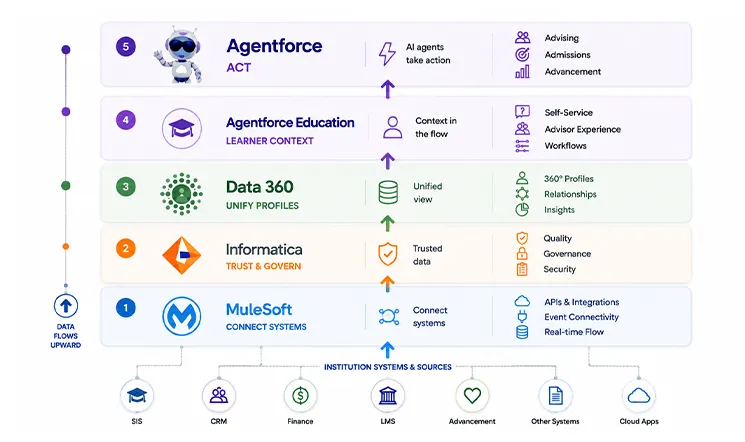
A connected Salesforce architecture changes that equation. MuleSoft connects the systems that power
the institution. Informatica helps ensure institutional data is trusted and governed. Data 360 unifies that
information and makes it actionable. Agentforce Education provides the context of the learner journey.
Agentforce can then use that foundation to reason, respond, and take action within the workflows
students and staff already use.
Agentforce can help advisors identify and support students who may need intervention by bringing
together signals from across the institution. It can help students find answers without requiring them to
understand which department or system holds the information they need. Admissions teams can deliver
more relevant engagement based on a prospect’s complete relationship with the institution.
Advancement teams can surface constituent insights and recommended actions without manually
searching across systems.
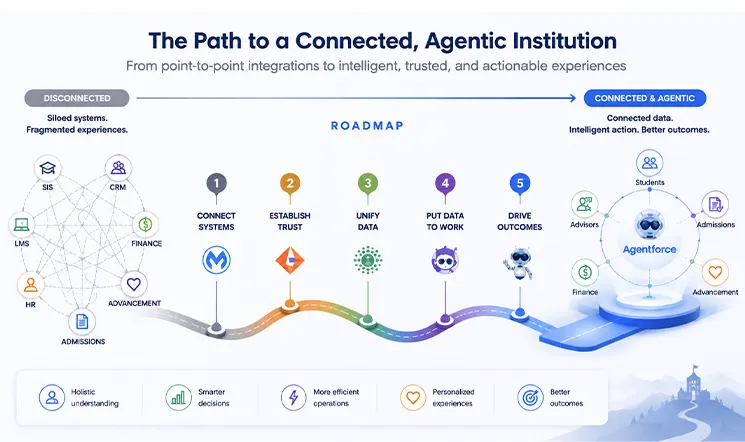
The progression is powerful: connect the systems, establish trust and governance, unify the data, put it
into the flow of work, and ultimately use it to drive better outcomes.
Don’t Just Replace Lingk. Reimagine What’s Possible.
For institutions evaluating their future with Lingk, the opportunity extends well beyond selecting
another integration tool. It is a chance to simplify an increasingly complex technology ecosystem, reduce
the technical debt created by point-to-point integrations, and establish an architecture designed to
evolve as institutional needs change.
A modern institutional architecture makes critical data accessible across the institution, creates a more
complete view of students and constituents, and supports scalable integration patterns that can adapt
as systems evolve. Just as importantly, it creates the trusted institutional context required for the next
generation of connected student experiences.
Bringing together MuleSoft, Informatica, Data 360, Agentforce Education, and Agentforce creates a
foundation where systems do more than exchange data. They work together to support a more
connected, intelligent institution, one where data can inform experiences, automate processes, surface
insights, and enable agents to take meaningful action.
Moving beyond Lingk is an opportunity to unlock greater value from institutional data and build a
foundation designed for how the institution needs to work today and in the years ahead.
Cloud for Good Can Help Build the Roadmap
At Cloud for Good, we help higher education institutions assess their existing integrations and data
architecture, identify opportunities to simplify and modernize their technology ecosystem, and build a
Salesforce roadmap designed around where the institution is going.
Whether the immediate priority is replacing an existing integration, reducing technical debt, creating a
more complete view of the learner, or preparing institutional data for Agentforce, the transition can
become a catalyst for a broader transformation.
Considering your next step beyond Lingk? Let’s explore what a connected, trusted Salesforce
architecture could look like for your institution.