
About the University of Michigan
The University of Michigan (U-M) is one of the world’s leading academic institutions, serving nearly 50,000 students across 19 schools and colleges at its main campus in Ann Arbor, MI. Among U-M’s most prestigious programs are the College of Engineering, the College of Literature, Science, and the Arts (LS&A), and the Ross School of Business. U-M’s Information and Information Technology Services (ITS) team uses platforms like Salesforce Education Cloud to serve as both a trusted enabler of technology and a provider of scalable solutions that support institutional goals and student success.
The Challenge: Navigating Salesforce’s Pivot to Education Cloud
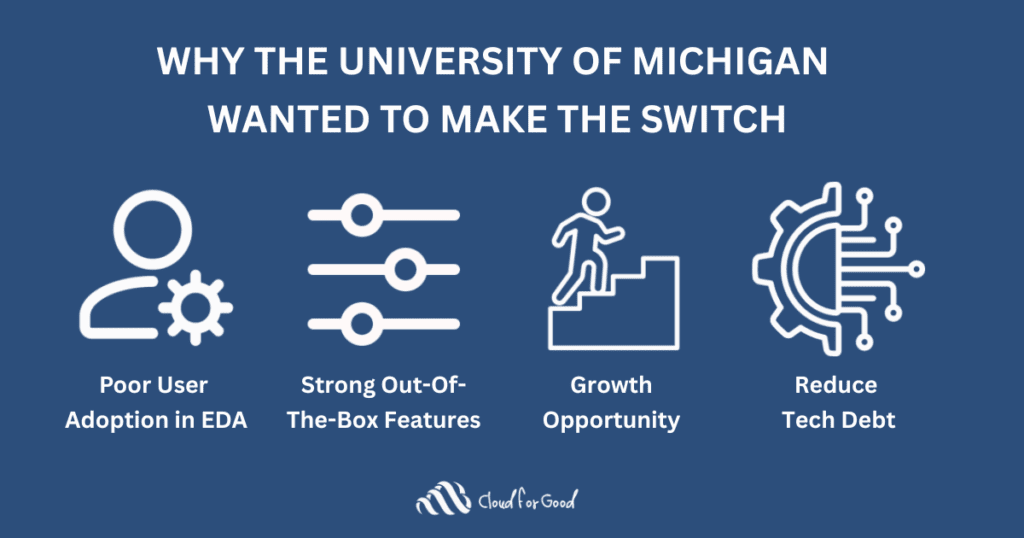
Two years into a successful Salesforce EDA implementation, U-M’s ITS team encountered a major product announcement: Salesforce Education Cloud. Knowing Salesforce’s upcoming innovation would likely be focused on Education Cloud over EDA, the ITS team was left at a crossroads:
Option 1: Stay on EDA
Build customizations on a platform that would ultimately become outdated, creating long-term technical debt and a more complex migration later.
Option 2: Migrate to Education Cloud
Adopt the future-facing platform early, with a smaller migration effort and greater alignment with Salesforce’s upcoming product roadmap.
Despite progress already made on EDA, U-M chose to migrate to Education Cloud. David Schmitke, Application Architect & Development Lead at U-M ITS, recalled:
“If we didn’t go to Education Cloud now, everything we’d build for the next three years would have us looking over our shoulders and being like, ‘Oh, man, we’re going to have to migrate that someday.’ The timing was really on our side. We saw the con of not moving early—of all that technical debt we’d incur.”
The Opportunity to Collaborate: Choosing the Right Strategic Partner
With a strong Salesforce Center of Excellence, U-M ITS had the technical capability to implement Education Cloud. Still, it needed guidance on strategy, trust-building, and stakeholder alignment across a large and traditionally siloed university.
Cloud for Good had partnered with business units at U-M’s main campus in the past, and based on internal recommendations and Cloud for Good’s experience with Education Cloud’s environment, architecture, and nuances—particularly Education Cloud for Recruitment & Admissions—U-M engaged Cloud for Good for advice and guidance for the migration.
The Solution: Strategic Advisory Services
Strategic Guidance on a Scalable, Future-Ready Platform Aligned With Salesforce’s Education Roadmap
Cloud for Good began by comparing EDA and Education Cloud data models to help the ITS team visualize both the current and future states of the U-M Ann Arbor campus CRM environment. This analysis clarified how migrating to Education Cloud would reduce technical debt and align with Salesforce’s higher education roadmap.
Schmitke shared:
“Cloud for Good did all the right things during our migration by providing phenomenal support and expertise with new technology. I really appreciated that they listened to our requirements and helped craft a statement of work that addressed the unique needs of our migration. In some aspects, no two customers are the same, and Cloud for Good understands that.”
The collaboration extended far beyond the initial scope of work and helped set the stage for the eventual Education Cloud implementation.
Empowering U-M with Change Management, Enablement, and Knowledge Transfer
Change management was prioritized throughout the engagement. With seven departmental tenants relying on the system, ITS created a communication plan that included a project website and monthly progress updates authored by Tuttle.
Cloud for Good introduced U-M to new Salesforce tools, such as OmniStudio with FlexCards, and built working models that demonstrated reusable patterns to accelerate delivery and minimize custom code.
Knowledge transfer was emphasized at every stage, enabling U-M’s Center of Excellence to independently manage future migrations and tenant onboarding.
Ann Tuttle shared:
“The knowledge transfer was invaluable. It was a key takeaway that set us up for success.”
Cloud for Good also stood up a clean Salesforce Education Cloud org that incorporated Experience Cloud portals, Event Management, Marketing Cloud, FormAssembly, Tableau, and Informatica Cloud integrations.
Tuttle noted:
“We didn’t just get a system. Cloud for Good helped us build the foundation and the skills to run with it ourselves.”
Outcomes & Tangible Results of Salesforce Education Cloud
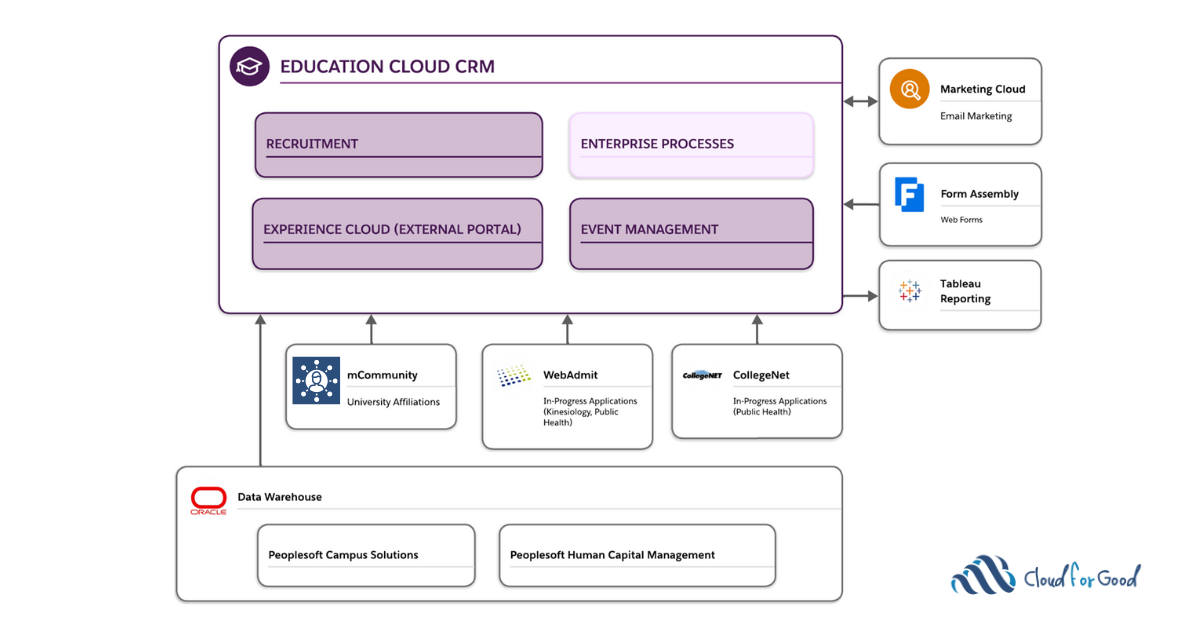
A Single, Scalable, Modern, Student-Focused Enterprise Platform: Salesforce Education Cloud
The migration to Salesforce Education Cloud delivered value immediately. By retiring a failing outsourced legacy unit website and replacing it with Experience Cloud and Event Management, U-M improved reliability and reduced ongoing costs.
U-M now has a single, scalable platform that supports all 19 schools and colleges. Education Cloud created a common foundation that allows flexibility while aligning around student-focused processes.
Schmitke explained:
“Enterprise is not easy at a decentralized institution. Part of the way we’re navigating those challenges is by prioritizing student-focused processes. Education Cloud is central to that strategy.”
Tools such as OmniStudio, FlexCards, Success Plans, and Interest Tags improved the student experience and reduced manual effort.
Momentum From Leadership and Campus: An Empowered ITS Team
Transparency built trust across U-M and increased leadership confidence. As the Salesforce Education Cloud proved successful, interest across campus grew.
Cloud for Good facilitated an on-site meeting between ITS and the Center for Academic Innovation—two units that previously had not collaborated on Salesforce. This meeting aligned teams on a unified vision for Education Cloud and sparked new cross-departmental synergy.
A happy hour organized by Cloud for Good further amplified support as CAI leaders shared benefits they were already seeing from joining the enterprise org. Knowledge transfer empowered the ITS team to own its roadmap, manage future migrations, and deliver new functionality independently.
Schmitke shared:
“The momentum we now have from leadership—and the confidence to pursue campus-wide solutions—is phenomenal.”
From Migration to Transformation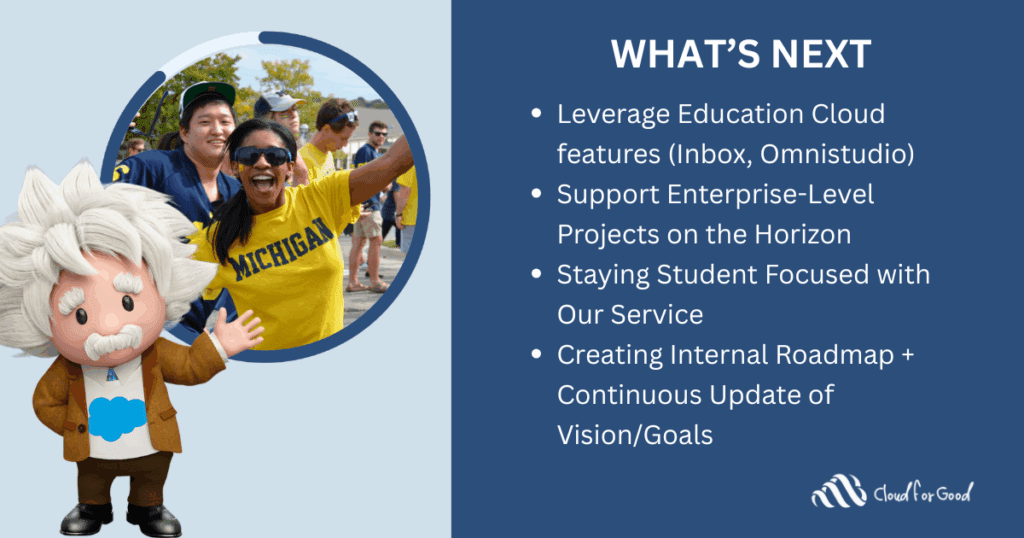
With a strong foundation in place, U-M is positioned to continue expanding Salesforce as a core enterprise system.
Tuttle shared:
“There are enterprise-level projects that are on the horizon that would support 19 schools, colleges, and students. That is super important to us, and Education Cloud puts us in that direction.”
Planning a Migration from EDA to Education Cloud?
Visit Cloud for Good for considerations for switching from EDA to Education Cloud to learn how our higher education practice can help you innovate with Salesforce while minimizing technical debt.