
Digital transformation has led many organizations to adopt a growing number of tools to support their operations. From marketing automation platforms and fundraising systems to analytics solutions and event management tools, each technology plays an important role in improving efficiency and enabling better decision-making.
However, as technology ecosystems expand, organizations often discover that the real challenge isn’t simply adopting new tools; it’s ensuring those tools integrate effectively within Salesforce.
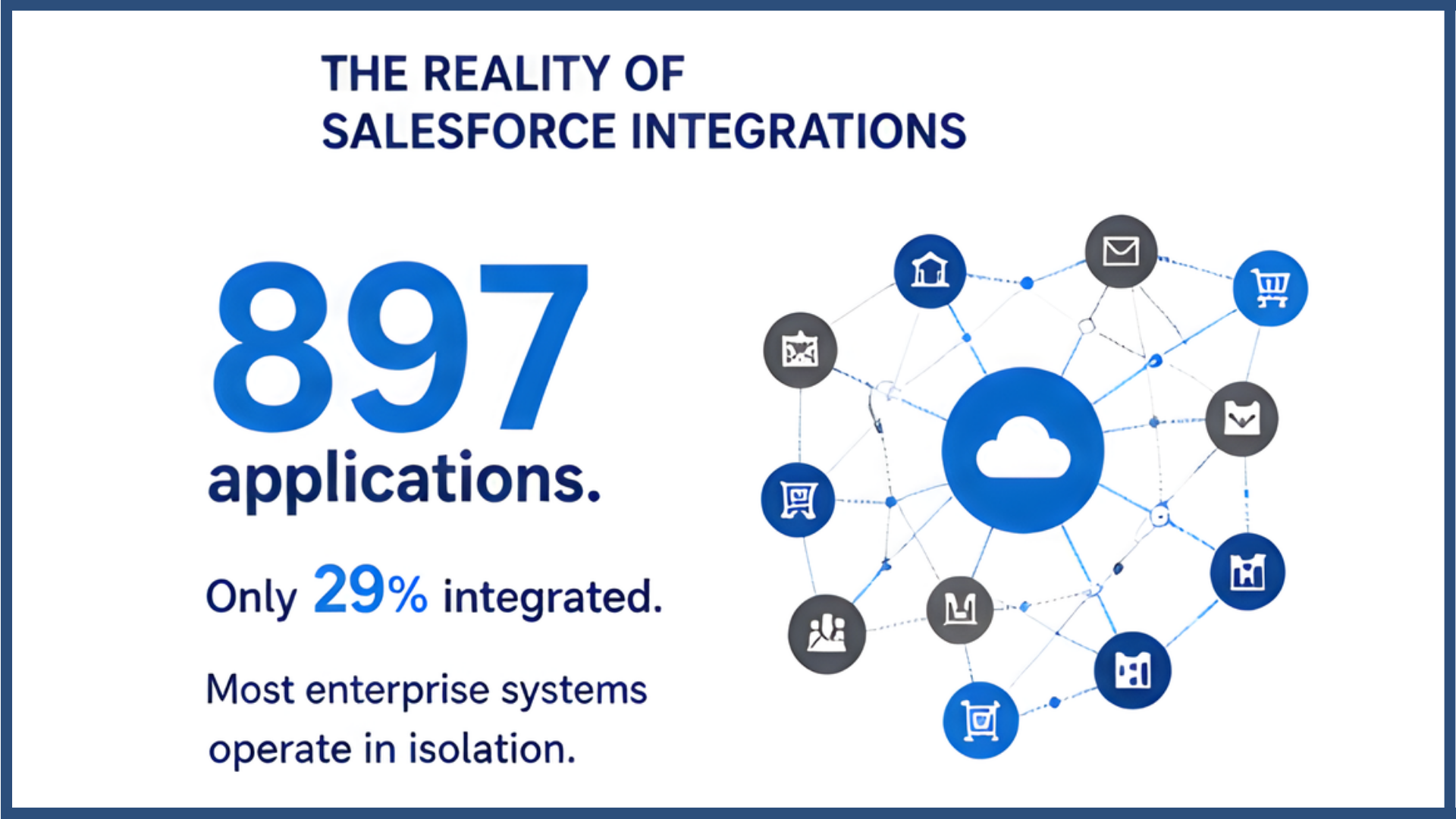
According to MuleSoft’s 2025 Connectivity Benchmark Report, conducted with Vanson Bourne and Deloitte Digital and based on responses from 1,050 IT leaders globally, the average enterprise now manages 897 applications, yet only 29% of them are integrated. That means nearly three-quarters of an organization’s technology stack is operating in isolation, creating hidden friction across every team that depends on connected data to do their jobs.
When integrations are approached as isolated projects rather than part of a broader strategy, gaps can begin to emerge across the system architecture. Over time, these gaps can affect data consistency, reporting accuracy, and operational efficiency.
This is where the difference between project-based implementations and long-term Salesforce partnerships becomes critical.
The Hidden Impact of Fragmented Salesforce Integrations
Salesforce is often the central hub of an organization’s technology stack. It connects critical systems, manages constituent data, and supports reporting across teams.
But when new tools are introduced without a cohesive integration strategy, organizations can experience fragmentation within their Salesforce ecosystem. MuleSoft’s 2024 Connectivity Benchmark Report found that 81% of IT leaders report data silos are actively hindering their digital transformation efforts, with 80% specifically citing silos as a primary concern.
Some common signs of fragmented integrations include:
- Duplicate or inconsistent data across systems.
- Manual processes created to reconcile disconnected workflows.
- Limited visibility into the full constituent or customer lifecycle.
- Reporting challenges due to disconnected data sources.
These issues rarely appear overnight. Instead, they develop gradually as organizations add new platforms and integrations over time. The MuleSoft 2025 report estimates that integration challenges cost organizations an average of $6.8 million annually in lost productivity and delayed projects, a figure that compounds quietly in the background with each new disconnected tool added to the stack.
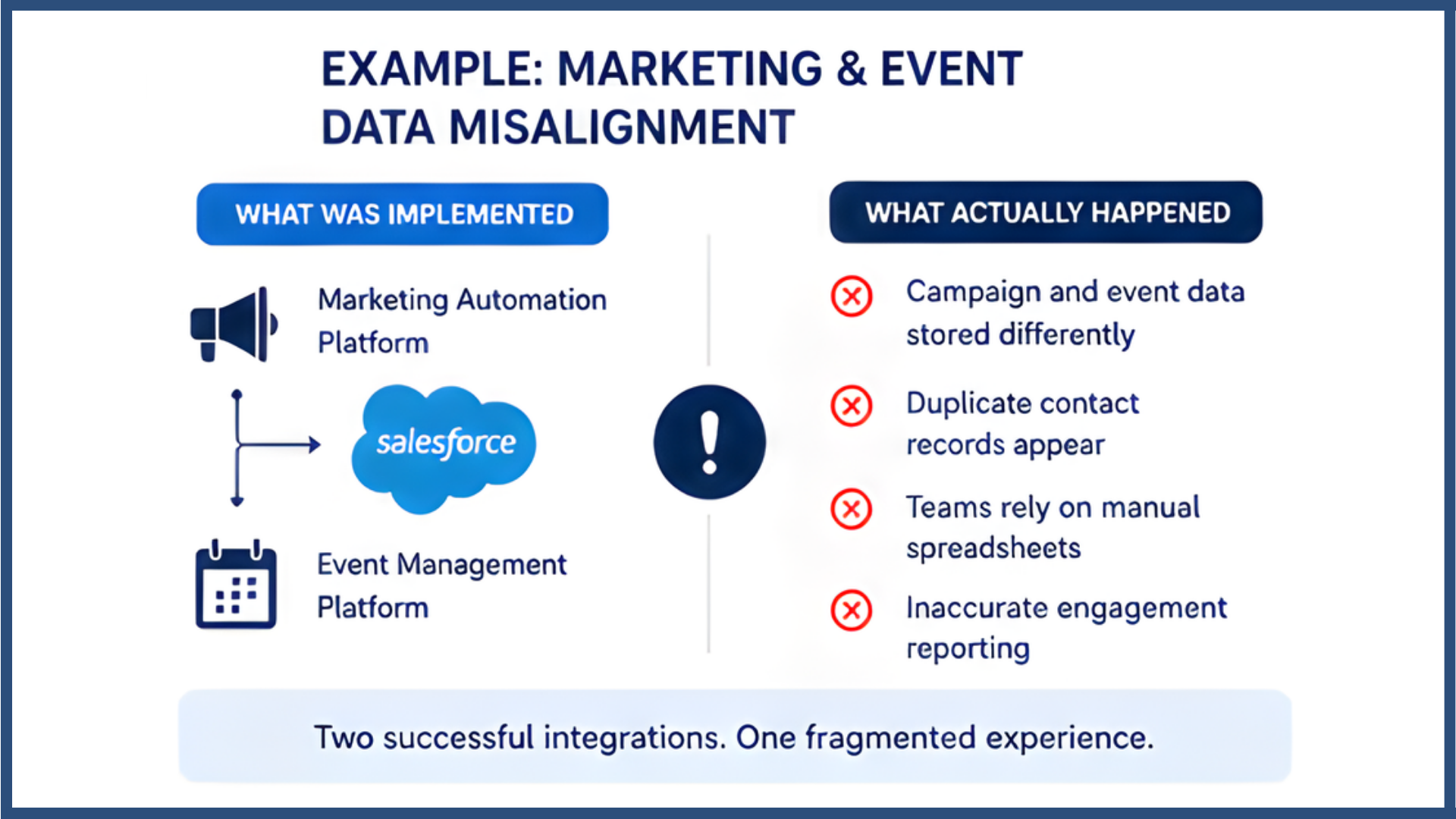
Example: Marketing and CRM Data Misalignment
Consider an organization that integrates a marketing automation platform with Salesforce to track campaign engagement. Months later, they introduced an event management platform to manage registrations.
Both systems technically connect to Salesforce, but because they were implemented independently, campaign engagement data and event participation data are stored differently.
As a result:
- Marketing teams struggle to create accurate engagement reports
- Duplicate contact records begin to appear
- Staff rely on manual spreadsheets to reconcile data
What began as two successful integrations eventually creates friction across teams. MuleSoft’s research also found that IT teams spend an average of 39% of their time designing, building, and testing custom integrations between systems, time that could be redirected to strategic priorities if integrations were managed within a coherent, long-term framework.
Why Salesforce Ecosystems Require Ongoing Optimization
A Salesforce environment is not static. As organizations grow, their processes evolve, reporting requirements change, and new technologies are introduced to support emerging priorities.
Each addition creates new integration points and data dependencies. According to Gartner, the average enterprise already spends 30-40% of its IT budget managing the complexity created by unintegrated applications. Without a structured integration strategy, every new tool added to a Salesforce ecosystem can quietly increase that burden.
Treating Salesforce as a one-time implementation often leads to technical complexity over time. Systems that once worked seamlessly may begin to show signs of misalignment as workflows change or additional tools are introduced.
Example: Fundraising Platform Expansion
A nonprofit organization might initially integrate its online donation platform with Salesforce to capture donor information.
A year later, the organization adds a peer-to-peer fundraising platform and a grant management system.
Without careful integration planning:
- Donation data may follow different structures across platforms
- Fundraising reports may require manual reconciliation
- Teams struggle to gain a unified view of donor engagement
What began as a simple integration gradually becomes difficult to manage. Eighty- three percent of IT leaders surveyed in MuleSoft’s report believe that delays in resolving integration challenges directly equate to lost revenue opportunities, a reality that is especially acute in mission-driven organizations where every dollar and every donor relationship counts.
The Value of Long-Term Salesforce Partnerships
This is where long-term Salesforce partnerships provide a strategic advantage.
Unlike one-off consulting engagements, long-term partners develop a deeper understanding of an organization’s technology landscape, operational processes, and growth goals. This ongoing relationship allows them to identify small inefficiencies that might otherwise go unnoticed.
Forrester Research has found that a well-executed Salesforce implementation can deliver up to 300% ROI over three years, and the quality of the consulting partner is often the deciding factor in whether that return is realized.
Over time, addressing these smaller gaps can significantly improve system performance and user experience.
Proactive Salesforce Integration Management
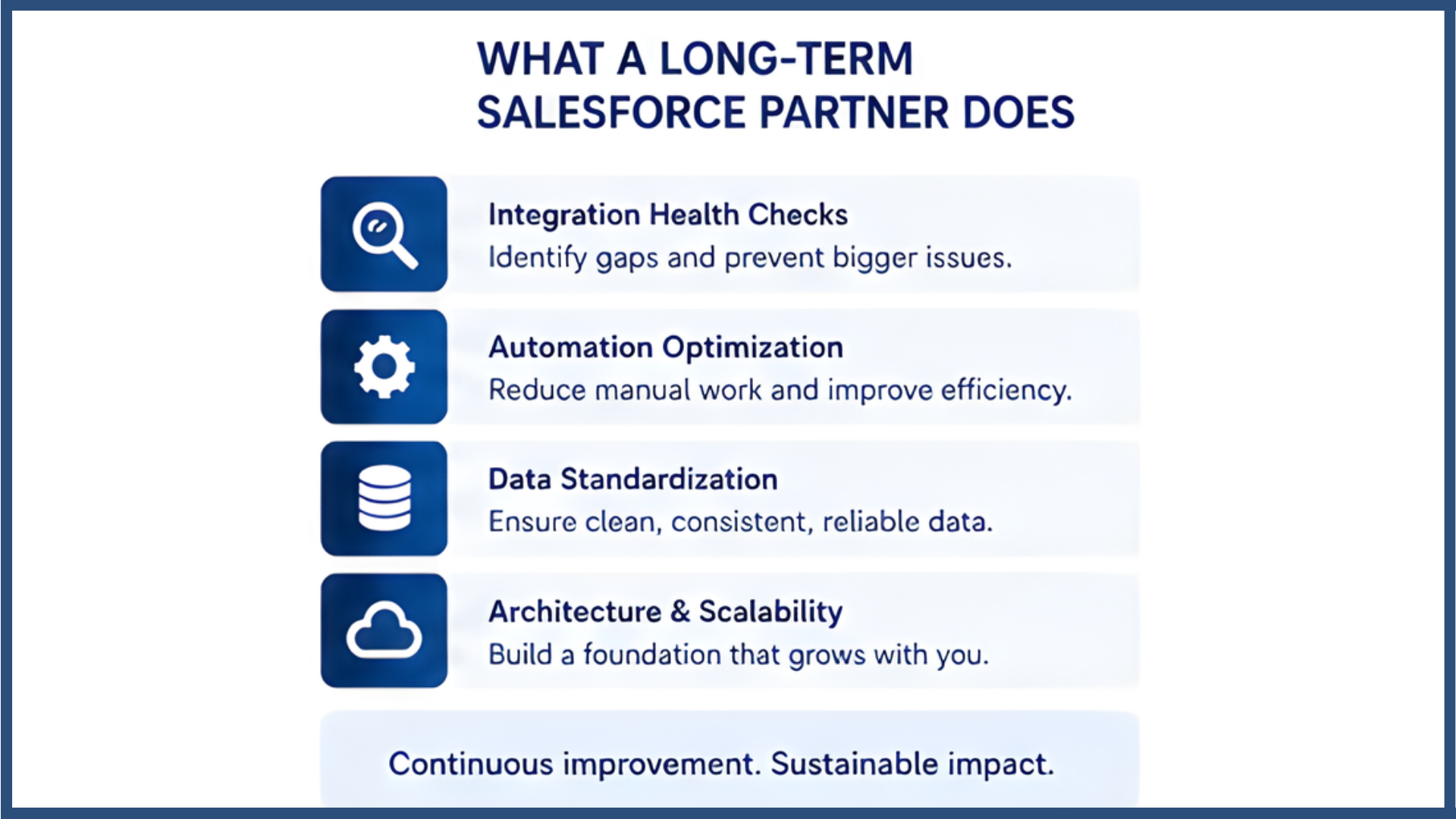
A long-term Salesforce consulting partner regularly evaluates how systems interact within the broader ecosystem. This helps ensure integrations remain scalable, efficient, and aligned with the organization’s evolving needs.
Use Case: Integration Health Checks
For example, a long-term partner might conduct periodic integration reviews to assess:
- Data flow between systems
- Automation performance
- Duplicate record creation
- API usage and system limit
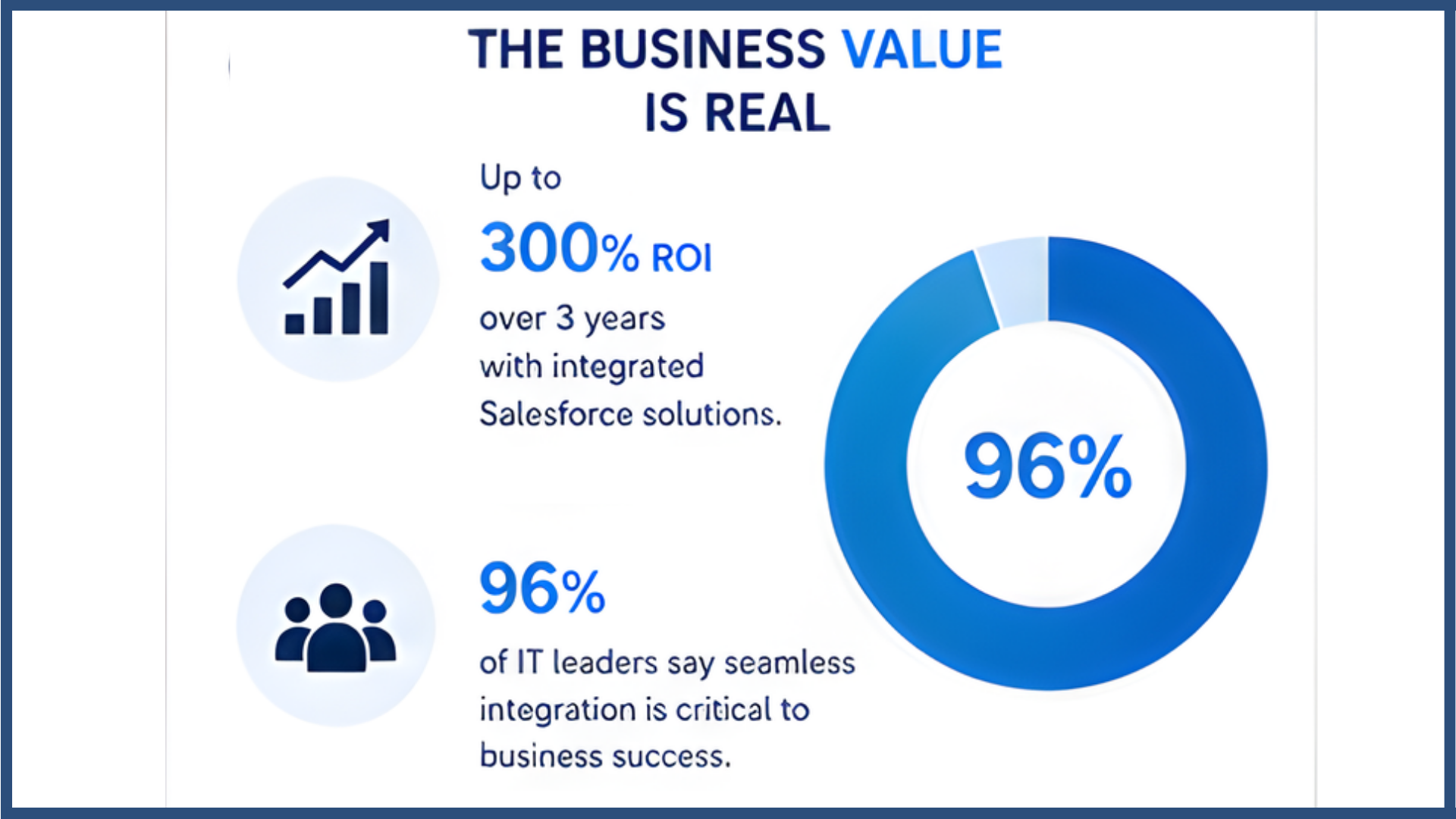
These reviews often reveal small issues, inefficient automations, or misaligned field mappings that can be corrected before they disrupt operations. MuleSoft’s 2026 Connectivity Benchmark Report, drawing on insights from over 1,000 IT leaders, found that 95% of organizations report facing challenges with integration, and 96% agree that seamless integration is now fundamental to achieving their core technology goals. Proactive reviews are the mechanism that keeps those challenges from escalating.
Early Detection of Integration Gaps
Many Salesforce challenges originate from minor configuration issues, workflow misalignments, or incomplete data mapping. While these issues may initially appear small, they can grow as new systems are introduced.
Use Case: Identifying Workflow Inefficiencies
An organization might notice that staff manually update records after an event or campaign because automation rules were configured years earlier. A long-term partner familiar with the organization’s processes can quickly identify these inefficiencies and implement automation improvements, saving staff hours of manual work.
A More Scalable Technology Architecture
Organizations that continuously expand their technology stack benefit from a structured integration strategy. A long-term partner helps ensure that new tools connect seamlessly with Salesforce rather than creating isolated workflows.
Example: Scaling a Salesforce Ecosystem
A higher education institution using Salesforce may integrate multiple platforms over time:
- Student recruitment tools.
- Marketing automation platforms.
- Event management systems.
- Alumni engagement solutions.
A long-term Salesforce partner ensures these systems share a consistent data model, enabling leadership to track the full lifecycle of a student, from prospect to engaged alumnus.
Without that architectural oversight, these systems may function independently but fail to provide meaningful insights across departments. MuleSoft’s Connectivity Benchmark found that 72% of IT leaders consider their current infrastructure overly interdependent, and 62% report their organizations are not equipped to harmonize their data systems effectively, a structural risk that grows with every new platform added without strategic oversight.
Continuous Salesforce Optimization
Iterative improvements to automation, data models, and reporting structures can significantly improve operational efficiency. With consistent oversight, organizations can refine their Salesforce environment and ensure the platform continues to support their evolving goals.
Use Case: Reporting and Data Visibility
A long-term partner might identify opportunities to:
- Standardize data across integrated systems
- Improve reporting dashboards
- Streamline automation between departments
These incremental changes can dramatically improve how teams interact with Salesforce daily.
Moving Beyond Project-Based Salesforce Consulting
Many organizations engage Salesforce consultants to address specific needs: implementing a new solution, fixing an integration issue, or resolving a technical challenge.
While project-based support can solve immediate problems, it often leaves broader system optimization unaddressed. As the Salesforce consulting landscape has evolved in 2025, organizations are increasingly moving beyond project-based engagements and seeking long-term partners who understand their industry, drive measurable ROI, and build future-proof solutions.
A long-term Salesforce partnership shifts the focus from isolated fixes to ongoing system health and performance.
This approach enables organizations to:
- Improve cross-system data visibility.
- Strengthen reporting and analytics.
- Reduce integration complexity.
- Increase operational efficiency.
Building a More Connected Salesforce Ecosystem
Technology should simplify operations, not introduce hidden complexity across systems. MuleSoft’s research makes clear that connected systems are no longer optional; seamless integration is now essential to delivering consistent employee and customer experiences.
At Cloud for Good, we work with organizations at every stage of their Salesforce journey: meeting them where they are through in-person consultancy, connecting siloed systems into unified integrations, and building a digital roadmap that aligns technology with long-term goals.
“We don’t just deliver technology. We deliver value.”
– Tal Frankfurt,
CEO & Founder, Cloud for Good.
That value is further amplified by our proprietary IP, purpose-built to personalize your Salesforce solutions. Our Cirrus Fundraising Agent, which uses AI to help advancement teams identify high-potential donors, personalize outreach, and shift fundraising strategy from reactive to predictive. Stratus accelerates your platform migration through AI-powered, org-to-org data and metadata migration, reducing risk and compressing timelines.
Cumulus Fundraising extends Nonprofit and Education Clouds with the critical fundraising capabilities organizations need today, from household management to advanced reporting.
And Cumulus Grant Management, which manages the entire grant lifecycle. from application through award, compliance, and impact tracking, all within Salesforce.
Together, these assets don’t just speed up delivery. They raise the standard of what a connected Salesforce ecosystem can do.
Ready to move beyond fragmented integrations? Let’s build your roadmap with Cloud for Good.