
By Chandler Jenkins
A Department of Transportation carries a load most residents never see. It stewards the infrastructure the country moves on and governs everyone who uses or affects it, from a carrier hauling a 300,000-pound transformer to a utility crew opening a lane.
The stakes under that work are rising. The ASCE 2025 Infrastructure Report Card finds that 6.8 percent of more than 623,000 US bridges are in poor condition, which makes the analysis behind a single oversize-load permit anything but a formality. Get it wrong and a load meets a bridge that cannot carry it. Yet much of this work still runs on manual review, disconnected databases, and staff cross-checking systems that were never built to talk to each other.
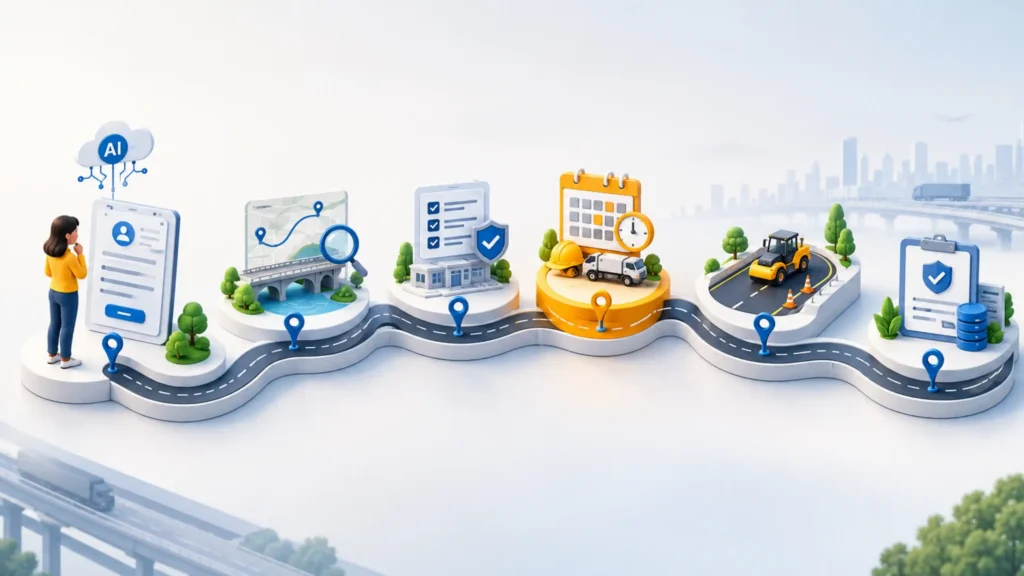
A modern platform changes that across the full DoT journey, from the moment an application arrives to the moment a crew is standing on the road. Here is what that looks like in practice, using the oversize and overweight permit as the throughline, with inspection and field work close behind.
Application Intake and Permit Matching
Process. A carrier applies for an oversize or overweight permit. A utility files an encroachment permit. A contractor requests right-of-way access. Each application must match the correct permit type, fee structure, and regulatory framework before review can even begin.
Challenge. A small error in load dimensions or route description triggers a rejection, and on a multi-state move each state’s rejection delays the whole convoy. Applications arrive under the wrong permit class, missing the load configuration the office needs. Staff spend their time correcting intake errors on applications that should never have entered the queue incomplete.
The solution:
- Guided, correct-the-first-time intake. Agentforce walks the applicant to the right permit type based on their load, route, and carrier status, so applications arrive structured correctly for the permit class.
- Errors caught at the door. Dimension and documentation gaps are flagged at submission, before they reach a reviewer and stall the move.
Route and Bridge Validation
Process. An oversize or overweight permit cannot issue until the proposed route is validated against bridge load ratings, vertical clearances, and state-specific thresholds. Texas permit officers, for example, check the Bridge Inspection Management System to confirm a route can carry a load before it is approved.
Challenge. This validation runs across bridge records, state dimension rules, and active restrictions, often checked by hand across separate systems. Idaho allows up to ten business days for a bridge analysis on the heaviest loads, and a truck fully compliant in one state can trigger violations the moment it crosses into the next.
The solution:
- Automated route pre-clearance. Connected to route and bridge data, Salesforce Public Sector Solutions validates standard loads against the bridge database automatically, clearing them faster.
- The right loads flagged for the right review. Loads that exceed thresholds are surfaced immediately for structural analysis rather than discovered midway through processing.
Review Routing and Approval
Process. Not every permit auto-issues. A superload heading through five states can take six to ten weeks to permit, and some states will not issue until adjacent states approve. The right reviewer depends on load characteristics, route, and the applicable rules.
Challenge. Manual routing sends a permit to the wrong queue. A load needing engineering review waits in the standard line. A multi-agency sign-off gets one approval when it needs two. The carrier operates against a permit window that keeps shrinking while corrections work their way through.
The solution:
- Condition-based case routing. Salesforce sends each application to the correct review level automatically, and thresholds trigger the right approval path without a staff member sorting it.
- Parallel, not sequential. Multi-approver workflows run at once, which matters most on the multi-state moves where sequential review costs weeks.
Scheduling the Field Work
Process. Much of the DoT’s work requires a qualified person in the physical world. A route survey requires a field representative to physically inspect and certify the path. A bridge inspection requires a certified inspector. A maintenance dispatch requires the right crew with the right equipment, and an incident response requires the nearest qualified operator, often with no advance notice.
Challenge. The DoT workforce is spread across regions, depots, and job sites. Certifications are legally non-negotiable; a hazardous materials inspector must hold specific federal qualifications before dispatch, and storm events trigger assignments with no warning. A spreadsheet has no live view of who is certified, who is available, and where they are.
The answer is not a standalone dispatch tool bolted beside the permit system. It is scheduling that lives inside the same record as the work order. GoMeddo runs natively in Salesforce, so an inspector’s certifications, availability, and location sit alongside the permit or work order that requires them. The right certified person matches the right site, and when an incident reroutes a crew, the schedule and work record move together because they were never two records to begin with.
When Seconds Decide the Outcome: Why Emergency Response Cannot Run on a Blind System
Execution in the Field
Process. The work happens on the road. The inspector completes the bridge assessment. The route survey is certified. The maintenance crew closes the job. Each outcome has to be recorded against the permit or work order it belongs to, from the field, as it happens.
Challenge. Field staff without real-time record access log outcomes later, from memory or paper. A result recorded hours after the fact, back at the office, invites data-entry errors and lost context. Permit conditions that require a verified result stay open until someone manually closes the loop.
The solution:
- Mobile access to the same record. Field staff log the outcome at the site, so the permit, the inspection, and the case close together, without a return trip to the office.
- One current source of truth. No paper, no reconstruction, no gap between what happened in the field and what the record says.
Compliance Record and Next Action
Process. A completed bridge inspection triggers a reinspection schedule. A permitted move generates an audit trail. An encroachment permit has close-out conditions. Every completed DoT action carries a next required action with a deadline.
Challenge. Next actions are tracked manually or not at all. A bridge flagged for reinspection is forgotten. A close-out condition goes unverified until a complaint surfaces the gap.
The solution:
- Automated next-action triggers. Agentforce sets and raises reinspection dates and close-out conditions on every completed record, without manual entry.
- Audit-ready at any point. The compliance record is complete and current whenever it is needed, not reconstructed after the fact.
One Platform Behind Every Function
Read the journey end to end and the shape is clear. A system of record underneath. AI-assisted intake, validation, and routing on top. Native scheduling at the station that puts a certified person on the road. A compliance record that closes every loop automatically.
Agentforce and Public Sector Solutions sit on the same Salesforce record. What a permit officer approves at a desk and what an inspector logs at a bridge are part of the same system. That is what separates a department that has automated a few tasks from one that has connected its entire operation.
Where Cloud for Good Comes In
Getting there takes more than a platform decision. It takes understanding how a specific DoT runs its bridge analysis, dispatches its storm crews, and reconciles its data with neighboring states, before touching a single configuration. That is the work Cloud for Good does.
The pattern is visible in the field work Cloud for Good has already delivered. Spectrum Child & Family Services ran licensing and case programs off a homegrown, paper-laden system, with field staff who travel up to four hundred miles round trip to a site and could not record what they found until they were back at the office, hours later, at the cost of accuracy and context. Cloud for Good moved them onto Salesforce case management with mobile access, so those field workers now open the case, create the assessment, and upload documentation on the spot. The billing solution even reconciles their data directly with the state’s systems, ending the duplicate entry that two disconnected systems forced.
The organization differs, but the theme is exactly the DoT’s: certified people working far from the office, licensing and compliance tied to state systems, and a record that has to be true in the field, not caught up later. As a trusted Salesforce advisor, Cloud for Good maps how the agency actually runs before touching a setting, aligns the people who have to live with the result, and configures Salesforce and Agentforce to the operation rather than the reverse.
Map Your Journey With Us
The best version of this starts with a whiteboard, not a software demo. Sit down with the Cloud for Good public sector team, map your DoT’s real operation from the application to the road, and see exactly where the gaps are costing you time, compliance risk, and field capacity today.