
For nonprofits still running on Blackbaud CRM, the question is no longer whether to move. It is how soon, and how well.
Think about the difference between a child’s favorite toy and a school.
The toy is a product. It is useful, even beloved, for a season. But it is bound by age and utility. It does not evolve. One day, you simply outgrow it.
School, on the other hand, is a platform. It builds a foundation. It grows with you. And long after formal education ends, what it gave you continues to compound.
That is the difference between Blackbaud CRM (BBCRM) and Salesforce.
And for nonprofits navigating an era of rising constituent expectations, tighter budgets, and accelerating technology, the distinction has never mattered more.
26,000+ Nonprofit and higher education organizations on Salesforce via the Power of Us program
2,500+ Salesforce implementations completed by Cloud for Good since 2010
$846M Nonprofit CRM market in 2025, undergoing its largest restructuring in a decade
The Core Problem: BBCRM Was Built for a Different Era

BBCRM was, for its time, a serious tool for serious organizations. Enterprise nonprofits, healthcare foundations, and large universities adopted it precisely because it handled complex constituent data at scale.
But technology does not stand still, and a platform that does not evolve becomes a liability.
The clearest signal came when Blackbaud discontinued support for Crystal Reports. For BBCRM users, Crystal Reports was not a peripheral feature. It was the primary path to complex reporting. Without it, organizations found themselves either locked out of the insights their CRM was supposed to deliver or forced to bolt on a separate BI tool like Tableau just to do what their CRM should have done natively.
“When your CRM can no longer produce the reports you need without a separate tool, it is not a CRM anymore. It is a data warehouse with a donor search bar.”
This matters deeply because reporting is not a nice-to-have. It is the core output of a CRM investment. If you cannot pull meaningful insights, segment your constituents intelligently, or measure program impact without engaging a database administrator or a third-party platform, your system is working against you.
A CRM that requires a technical intermediary to unlock its value is a technical debt, not a technology asset.
The Reporting Gap: Salesforce Gives Reporting Back to Your People
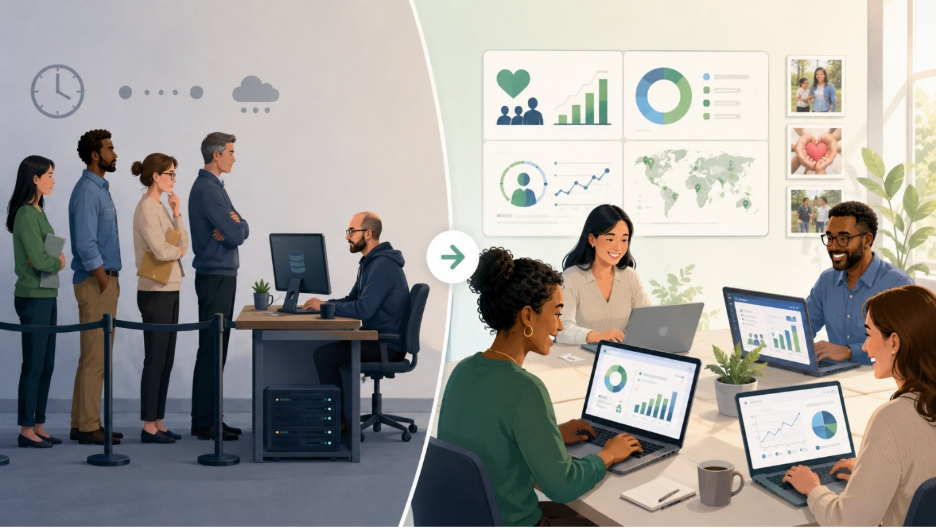
On BBCRM, the path to a complex report runs through a Database Administrator. Not every team member has a database mindset, and not every organization has the luxury of a dedicated DBA. As a result, the reporting bottleneck slows decision-making and creates dependency on technical staff for what should be a self-service capability.
Salesforce approaches reporting differently. Its drag-and-drop interface is built for the people who actually use the data, not just the people who manage it.
A fundraiser can build a report on household giving trends without filing a request. A program officer can pull participant outcomes without knowing a line of SQL. And because Salesforce is an object-oriented platform, a single report on Accounts can surface contacts, giving summaries, relationship history, and program engagement all at once.
Real-World Impact
Organizations migrating from BBCRM to Salesforce with Cloud for Good consistently report a significant reduction in time spent on manual reporting, freeing up staff capacity for relationship-building and mission delivery rather than data wrangling.
Platform vs. Product: A System You Make Your Own
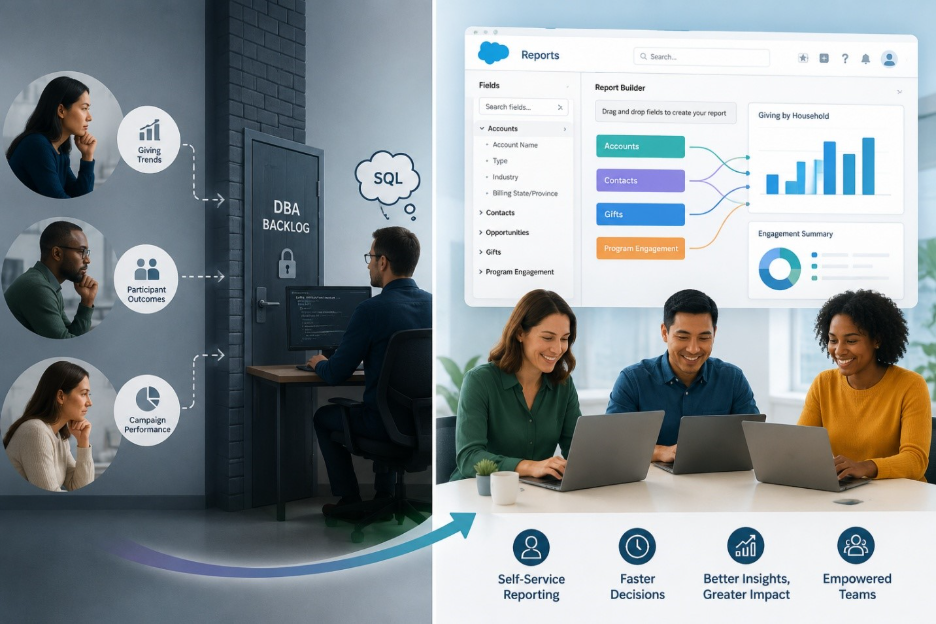
BBCRM asks organizations to adapt to it. Salesforce adapts to organizations.
That is not a subtle distinction. It is the difference between wearing someone else’s shoes and having a pair made for your specific stride.
Salesforce is an open, extensible platform with an AppExchange marketplace that connects to virtually every tool a nonprofit uses, from email marketing and payment processing to accounting and volunteer management. You are not locked into a closed ecosystem. Instead, you build the environment that matches your mission, your workflows, and your team’s way of working.
For organizations at any stage, whether a growing mid-sized nonprofit or a large enterprise institution, this matters. You should not have to replace your CRM every time your organization evolves. You should have a platform that scales with your ambition.
“The right question is not which CRM fits your organization today. Which platform will still be serving your mission five years from now?”
The Investment Case: Invest With Future-Oriented Thinking
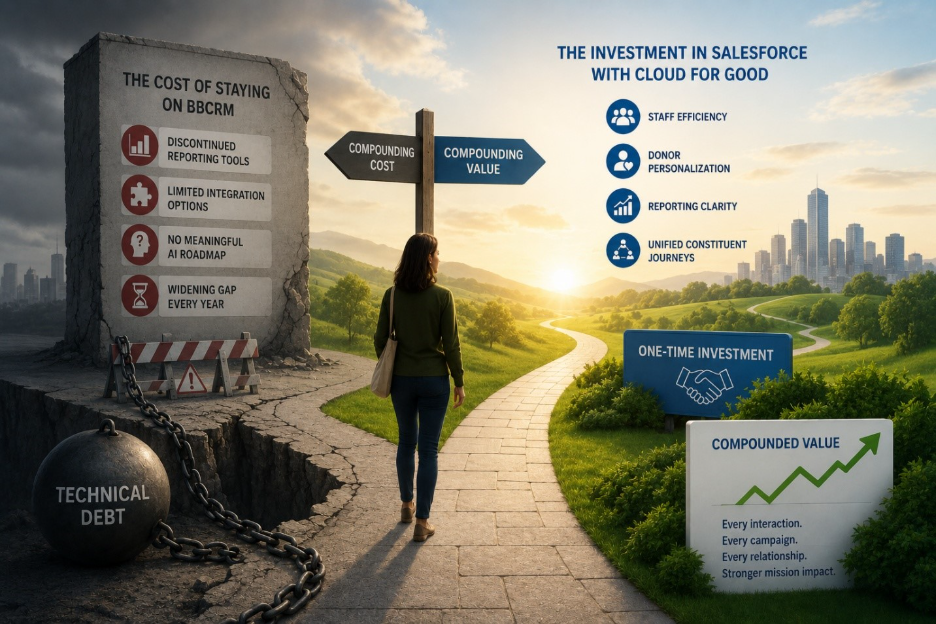
The nonprofit sector is in the middle of its most significant CRM migration wave in a decade. The organizations moving now are not reacting to a crisis. They are getting ahead of one.
Staying on BBCRM carries a compounding cost. Every year spent on a platform with discontinued reporting tools, limited integration options, and no meaningful AI roadmap is a year of widening gap between your technology and your mission potential.
The transition investment in Salesforce, particularly with a partner like Cloud for Good that brings purpose-built accelerators & IP Assets for nonprofits and higher education, is a one-time cost. The returns, in staff efficiency, donor personalization, reporting clarity, and unified constituent journeys, are ongoing.
A dollar invested in the right platform today does not return a dollar. It returns the compounded value of every interaction, every campaign, and every relationship your team manages more effectively because your system finally works for them.
The Cloud for Good Difference
Cloud for Good has completed over 2,500+ Salesforce implementations since 2010, with deep expertise in nonprofit and higher education migrations from Blackbaud. Our pre-built accelerators reduce implementation time and deliver mission-ready functionality from day one, so organizations spend less time configuring and more time connecting with the constituents they serve.
The Bottom Line: Choose a System That Grows With You
It does not matter whether you are a small nonprofit just formalizing your donor data, a mid-level organization outgrowing spreadsheet-era tools, or a large enterprise institution managing millions of constituent records. The principle is the same.
Choose a platform, not a product. Choose a system that compounds your investment rather than constraining it.
BBCRM served a generation of mission-driven organizations. But with its legacy reporting infrastructure gone, its ecosystem closed, and the broader technology landscape accelerating, it is increasingly a system that organizations work around rather than with.
Salesforce, backed by a trusted implementation partner, is the platform that meets nonprofits where they are and takes them where they need to go.
Ready to explore what a move to Salesforce looks like for your organization? Reach out to Cloud for Good at cloud4good.com