


Astha Panchal | Practice Director, AI & Data Services | Cloud for Good
Astha Panchal helps mission-driven organizations turn complex data into trusted insights and AI-ready foundations. With 20+ years in Data Services & Governance and 15+ years in Salesforce implementations, Astha helps connect data, AI, and technology strategy to drive meaningful outcomes.
Key Points
- 87% of data leaders say their data is AI-ready. 43% say data readiness is their biggest barrier to AI. That gap is where agent deployments fail.
- Data 360 unifies fragmented data into complete, governed profiles across every system your organization uses.
- Tableau Next surfaces insights at the right moment and gives every team and every agent a shared vocabulary through Tableau Semantics.
- Agentforce is only as reliable as the data underneath it. The foundation comes first.
The pattern shows up across every organization we work with.
At Malala Fund, supporter information was scattered across disconnected systems, limiting visibility and diverting staff time to system navigation. At DePaul University, student data lived across 37 data streams, 6 platforms, and more than 95 million records, with no unified picture of any one student. At Feeding America, years of workarounds had accumulated around a data warehouse too rigid to keep pace with the organization’s programs.
Across the sectors we serve, these scenarios are routine.
The 2026 State of Data Integrity and AI Readiness report by Drexel University’s LeBow College of Business and Precisely surveyed 505 data and analytics leaders and found that 87% say their organization’s data is AI-ready, while 43% of those same leaders identify data readiness as their biggest barrier to AI. That confidence-reality gap is where agent deployments stall.
The question organizations ask most often is where to start. Start with your goals. Define the outcomes you are working toward, build your KPIs around them, and then build your data strategy to serve that plan. Data 360 and Tableau Next are where the technology meets that intent. And once that foundation is in place, Agentforce is where it goes.
What Is Data 360?
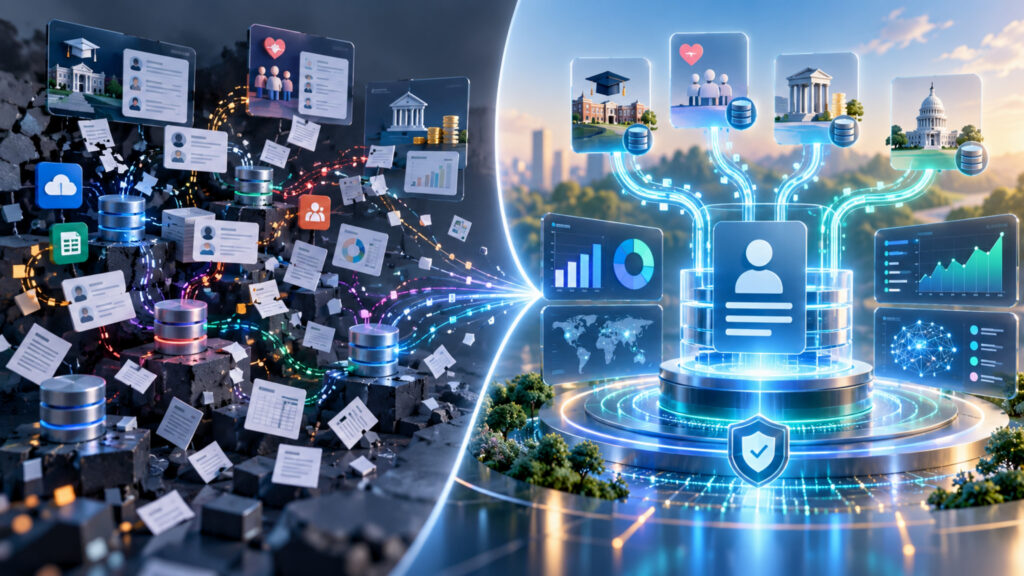
Most organizations have a data fragmentation problem. The information exists, but it lives in systems that have never been asked to speak to each other, and so every decision, every outreach, every agent action gets made on a partial picture. The pieces exist, but without a unified view.
That gap is what Data 360 closes.
Data 360 is Salesforce’s unified data platform. It reaches across every system an organization uses, from CRM to finance to program management to communication tools, and resolves what sits across them into complete, unified, continuously updated profiles. Not a snapshot. A living view of every constituent, student, member, or resident, built from every interaction they have had with your organization, kept current as those interactions continue.
| Nonprofit | Higher Education | Financial Services | Public Sector |
| A donor’s giving history, event attendance, volunteer activity, and email engagement are consolidated into a single profile. No duplicate appeals. No reconciliation by hand. | A student’s SIS record, LMS activity, advising notes, and financial aid status connect into a single view. Advisors see the full picture without switching systems. | A member’s accounts, loan history, and service interactions are unified into a single record. No duplicate entries, no conflicting data across branches or channels. | A resident’s history across multiple programs and case types connects across departments. One record, accessible to every authorized team. |
As Salesforce affirmed at Dreamforce 2026, Data 360 turns curated data into actual context. Not a record. Not a report. The full picture of who someone is, what their relationship with your organization has been, and what they are likely to need next, available the moment it matters. Every communication, every decision, and every agent action that follows draws from this layer. What gets built on top of it is only ever as strong as what sits here.
What Is Tableau Next?
Most teams already have the right data. They are short on the moment when that data becomes useful, and the ability to act on it without switching tools, looking for reports, or waiting for the next dashboard refresh.
Tableau Next is built on Data 360 and designed around that gap. It is Salesforce’s analytics platform, and its job is to move the distance between insight and action as close to zero as possible.
Three capabilities make that concrete:
Inspector runs in the background, watching for shifts in your data as they happen. When something changes, the right person finds out, without having to go looking.
Concierge lets any team member ask a question in plain language and get back an answer, a root cause, and a recommended course of action, without a data analyst in the middle.
Data Pro does the heavy lifting on modeling and preparation, so teams spend time on decisions rather than on getting data ready to analyze.
Holding all three together is Tableau Semantics. It is the shared dictionary that makes sure “lapsed donor,” “at-risk student,” or “active member” means the same thing whether a program officer, an enrollment counselor, or an AI agent is reading it. Consistent definitions produce consistent decisions.
| Nonprofit | Higher Education | Financial Services | Public Sector |
| A fundraising director sees which donors are lapsing and which attended events but never made a gift. Both cohorts are surfaced. The team decides what to do next. | An enrollment team sees which prospective students have engaged with every communication but have not submitted an application. The signal is there. The outreach follows. | A branch team identifies members who hold accounts with low engagement but high loan activity. The pattern is visible before attrition becomes a risk. | A program manager sees service delivery gaps across zip codes before they become compliance issues. Insights reach the level at which decisions are made. |
Tableau Next reads what happened and puts the right insight in front of the right person at the right moment, turning data from a record of the past into a catalyst for action. That is the shift from reporting to decision support.

What Changes When Agentforce Has the Right Foundation
Think of Agentforce as the person carrying out the work. Data 360 is what that person can see, and Tableau Next is what tells them when to move.
If the records are duplicated, incomplete, or siloed across systems, the agent does not pause to question them. It acts on what it finds. A donor gets two appeals. A student at risk gets missed because their LMS data never connected to their advising record. A member gets a generic response because half their service history lives in a different system.
The foundation determines what the agent is capable of. Clean, unified, governed data means agents that act accurately and at the right moment. Fragmented data means agents that act confidently on the wrong picture.
With the foundation in place, the picture changes.
| Nonprofit | Higher Education | Financial Services | Public Sector |
| An agent identifies lapsed donors, cross-references giving history with event and email engagement, and times outreach based on behavioral signals. The team’s strategy stays the same. Its reach and precision scale. | At DePaul University, once Data Cloud unified 37 data streams into a single student profile, the university flagged 2,000 students (10% of the population) at risk and reached them before problems escalated. | A member support agent reads from a complete, unified profile and adjusts its approach based on full service history. The context is already there. No intake from scratch. | An agent pulls a constituent’s full program and service history across departments from the first moment of contact. Intake that would span multiple interactions happens once. |
At Dreamforce 2026, Salesforce reported that Agentforce has reached more than 30,000 customers and delivered 7 billion agent work units. That scale reflects how quickly this technology is moving from pilot to production. It also raises the stakes for what sits underneath it.
The Organizations Ready for What Comes Next
Agentforce is maturing quickly. What it can do today for nonprofits, higher education institutions, credit unions, and government agencies is substantive. What it can do tomorrow depends on whether the data underneath it is trustworthy today.
The 2026 Drexel LeBow and Precisely report is direct on this point: without trustworthy, well-governed data, organizations cannot safely grant agents decision-making authority. The organizations building clean, unified, governed data environments now are the ones that will confidently activate agents.
The work of getting there is foundational. At Cloud for Good, it always has been.
Ready to build the data foundation your agents need? Talk to Cloud for Good about Data 360, Tableau Next, and Agentforce for your organization.