

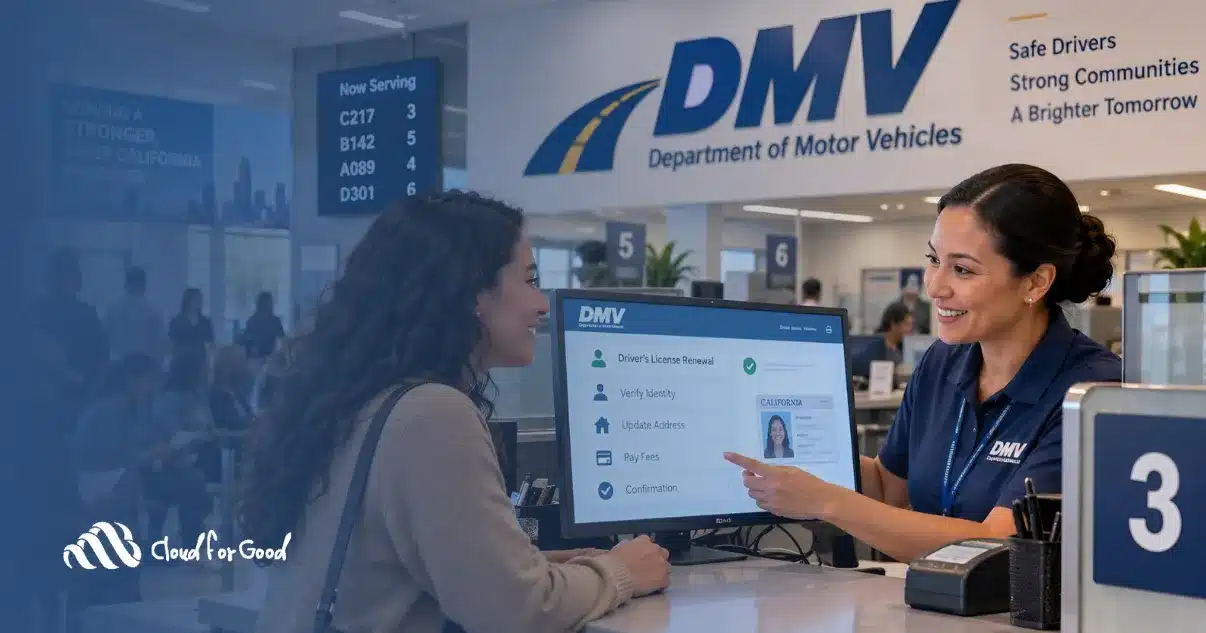
By Tim Love, Managing Director, Sales – Nonprofit and State & Local, Cloud for Good
Let us understand the ground-level solutions to the toughest challenges at the lifelines of vehicular
commute.
The scale a DMV carries is hard to overstate. Federal figures put the number of licensed drivers in the
United States at more than 237 million, roughly 85 percent of the driving-age population. Behind that
number sits one of the highest-volume, most-visited government operations in the country, and it
serves those residents across a widening set of channels: online, mobile, mail, phone, and the
counter.
The systems behind that scale have often not kept pace. Much of the work still runs on manual
lookups, disconnected records, and institutional knowledge that lives in one long-tenured employee’s
memory. The result is a familiar one for residents and staff alike: long waits, repeated questions, and
applications that stall for reasons no one flagged early enough.
A modern platform changes that, function by function, across the full DMV journey. Here is what that
looks like in practice.
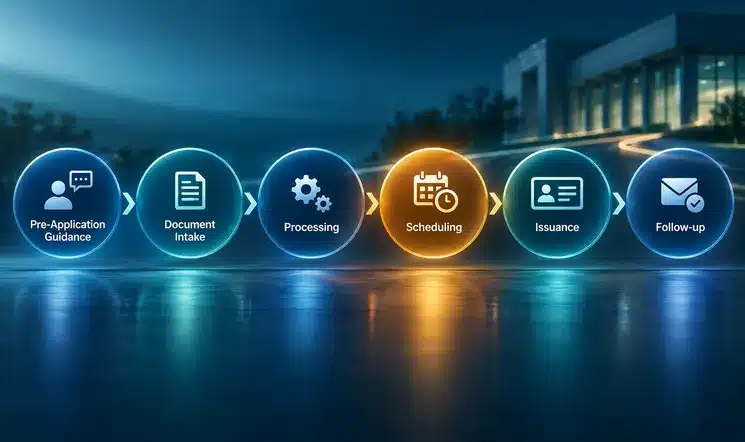
Pre-Application Guidance
Process. A resident arrives wanting to register or file for a driver license, disabled placard, complaint,
record request, or title transfer. Before anything moves forward, they need a clear picture of the
process ahead, what the filing requires, what documents apply to their specific situation, and what to
expect at each stage.
Challenge. DMV counters absorb the same redundant questions daily. Citizens arrive uninformed,
ineligible, or with the wrong documents. Every failed interaction costs a staff hour and a resident’s
time.
The solution:
- Redundant queries eliminated. An Agentforce AI agent handles repeat questions in real time,
before the citizen registers or calls. - Personalized checklist on demand. The resident selects their need, renewal, placard, CDL, title
transfer, and receives a dynamic guide built for their exact situation: documents required,
applicable fees, online versus in-person eligibility. - Eligibility flagged before arrival. Outstanding tickets, holds, or missing prerequisites surface
before the citizen enters the queue, not after. - An informed citizen at the door. By the time they begin, they are prepared and eligible, or they
know precisely what is blocking them and how to resolve it.
Document Intake and Verification
Process. The resident submits the documents their filing requires. A renewal requires proof of identity and residency. A REAL ID upgrade needs a birth certificate, Social Security document, and two proofs of address. A CDL endorsement needs medical certification. A disabled placard needs a physician statement.
Challenge. Even a prepared citizen can carry a complex case. Requirements vary by age, legal status, and filing type, and self-reported documents must be verified against the actual record rather than taken at face value. Manual verification is slow and inconsistent across staff.
The solution:
- Guided, situation-specific intake. Agentforce presents the exact checklist for the resident’s filing type and personal circumstances, not a generic list.
- Verification against the record. Submitted documents are checked against DMV and connected records, so discrepancies surface immediately.
- Complete applications only. Missing or invalid documents are flagged at submission, so the review queue receives applications that are ready to process.
Processing and Determination
Process. Once documents clear, the request moves to determination. A clean renewal processes automatically. A reinstatement after suspension triggers a hearing. A disabled placard routes to medical review. An emissions result decides whether registration proceeds. Each filing routes based on the specific conditions in the resident’s record.
Challenge. Routing that should be automatic is done by hand, across systems that do not share data. A case needing a hearing lands in the standard queue. A review waits behind routine work. Staff correct routing errors that have already cost time.
The solution:
- Automated, condition-based routing. Salesforce Public Sector Solutions sends each case to the right path based on record conditions, with no manual sorting.
- Straight-through processing for clean cases. A standard renewal completes without a staff touch.
- Context delivered to staff. For cases that need judgment, Agentforce surfaces the applicable policy and checklist, so the staff member has full context without a manual lookup.
Scheduling, When Physical Presence Is Required
Process. Many DMV filings are completed online or at the counter. Some require a qualified staff member at a specific place and time: a road test, in-person REAL ID verification, a driver safety hearing, or a medical review appointment.
Challenge. Branch capacity, examiner qualifications, and appointment slots are managed across spreadsheets and phone calls. No one has a live view of which examiner is qualified for which test, which branch has capacity, and whether staffing can absorb the next wave. Branches run short on peak mornings, and residents face delays unrelated to their own case.
The solution here is not a bolt-on booking tool. It is scheduling that lives inside the same record as the case itself. GoMeddo runs natively in Salesforce, so an examiner’s certifications, availability, and branch capacity sit alongside the resident’s appointment rather than in a separate calendar that has to be reconciled. The right qualified examiner is matched to the right appointment at a branch with real capacity, and the match is made once and made right, without the phone calls and spreadsheet cross-checks that break down at volume.
Issuance and Delivery
Process. An approved request produces a credential: a license, placard, registration, title, or a temporary paper credential issued while the permanent one is mailed.
Challenge. Issuance across credential types, each with its own timeline and delivery channel, is tracked across systems that do not update each other. Residents call to ask where their credential is, and staff has no better answer than the last manual queue check.
The solution:
- Live status on one record. The Salesforce record updates through production and delivery, visible to staff and residents.
- Proactive notification. Automated updates reach the resident when their credential is produced and dispatched, before they call.
Follow-up, Renewal, and Compliance
Process. Every credential expires, and every compliance condition has a deadline. Licenses, placards, emissions certifications, and reinstatement conditions all carry recurring obligations the agency must track.
Challenge. Follow-up is reactive. The resident forgets to renew. A deadline passes unnoticed. The agency sends a notice after the violation has already occurred.
The solution:
- Automated reminders. Agentforce raises renewal and compliance notifications on the record, without staff intervention.
- Ahead of the deadline, not behind it. The next action is surfaced before the obligation lapses, protecting the resident and the agency.
One Platform Behind Every Function
Read the journey end to end, and the shape is clear. A system of record underneath. AI-assisted guidance, intake, and routing on top. Native scheduling at the one station that needs a person in the room. A compliance record that closes every loop automatically.
Agentforce and Public Sector Solutions sit on the same Salesforce record. What a resident sees in the portal and what an examiner logs at the counter are part of the same system. That is what separates a department that has automated a few tasks from one that has connected its entire operation.
Where Cloud for Good Comes In
Getting there takes more than a platform decision. It takes understanding how a specific DMV routes its reinstatement hearings and staffs its busiest branches before touching a single configuration. That is the work Cloud for Good does.
The pattern holds across every constituent-facing agency Cloud for Good works with. CK Family Services, an organization serving at-risk children and families, faced the same core problem a DMV faces: constituents navigating requirements, staff drowning in manual steps, and compliance deadlines that depended on someone remembering them. Cloud for Good built a self-service portal on Experience Cloud with intuitive dashboards and requirement notifications, so families maintain their own documentation, and automated the approval workflows behind it. The result is the kind of outcome a DMV wants at its own follow-up and compliance stage: 95 percent of incident reports now reach the state on time, up from a manual process that could not guarantee it.
The department differs. The theme is identical: guide the constituent through their own requirements, connect the field to the record, and let the system carry the compliance the staff used to carry by hand. As a trusted Salesforce advisor, Cloud for Good maps how the agency actually runs before touching a setting, aligns the people who have to live with the result, and configures Salesforce and Agentforce to the operation rather than the reverse.
Map Your Journey With Us
The best version of this starts with a whiteboard, not a software demo. Sit down with the Cloud for Good public sector team, map your DMV’s real operation from the first click to the counter, and see exactly where the gaps are costing you time, accuracy, and staff capacity today.